The echo of sandals crunching over the dust of ancient roads resounds across the centuries. These are the footsteps of a man who, through the strength of his faith and the eloquence of his word, transformed the course of history. We are speaking of Paul of Tarsus, the Apostle of the Gentiles, whose tireless missionary work across the lands of Asia Minor —modern-day Turkey— laid the foundations of Christianity in the West.
Today, following in his footsteps has become, alongside the Camino de Santiago, one of the most fascinating and profound pilgrimage routes that a spiritual traveller can undertake.
For today’s pilgrim, this route presents itself as an adventure of discovery. It is not merely a physical journey through breathtaking landscapes and ruins that tell stories thousands of years old, but also an immersion into the very origins of the Christian faith. It is an opportunity to connect with the true essence of pilgrimage: the inner journey, reflection, and an encounter with a history that has shaped our civilisation.
At Mundiplus, specialists in accompanying pilgrims on their journey, we understand this search for meaning and transcendence. For this reason, we want to provide you with comprehensive information about this route, which has so much in common with other great pilgrimages.
Índice de contenidos
- 1 Who was Saint Paul and why is he so relevant?
- 2 The Route of Saint Paul in Turkey: a journey to the origins of Christianity
- 3 The Route of Saint Paul versus the Camino de Santiago: two pilgrimages, one shared spirit
- 4 Stages and must-see places on the Route of Saint Paul
- 4.1 Tarsus, the Apostle’s birthplace
- 4.2 Perge and Aspendos, the gateways to Pamphylia
- 4.3 Antioch of Pisidia, the sermon that changed everything
- 4.4 Iconium, Lystra and Derbe: the heart of Lycaonia
- 4.5 Ephesus, the metropolis of Asia Minor:
- 4.6 The Seven Churches of the Apocalypse: a Pauline echo at the end of time
- 5 Practical advice for pilgrims on the Route of Saint Paul
- 6 A journey that transforms
Who was Saint Paul and why is he so relevant?
To understand the magnitude of this route, it is essential to know its protagonist. Saul of Tarsus, a Roman citizen of Jewish descent and a devout Pharisee, was initially a fierce persecutor of the early Christians. However, his life took a radical turn on the road to Damascus, where a vision of the risen Jesus Christ transformed him into the most fervent of His apostles.
From that moment on, under the name of Paul, he dedicated his existence to a titanic mission: to carry the message of the Gospel beyond the boundaries of Judaism, opening it to the “Gentiles”, that is, to all non-Jewish peoples of the Roman Empire.
His three great missionary journeys, documented in the Acts of the Apostles and in his own epistles of the New Testament, led him to travel thousands of kilometres by land and sea. It was in Asia Minor that he founded some of the earliest and most important Christian communities in cities such as Antioch, Ephesus, Iconium and Lystra.
His legacy lies not only in the geography he traversed, but in his theology, which articulated fundamental concepts of Christianity and whose letters continue to be a source of inspiration and study. To pilgrimage in his footsteps is, ultimately, to walk upon the very foundations of the Christian faith.
The Route of Saint Paul in Turkey: a journey to the origins of Christianity
The Route of Saint Paul is not a single, unified and fully waymarked path like the Camino de Santiago, but rather a concept that encompasses the itineraries of his journeys through Turkey.
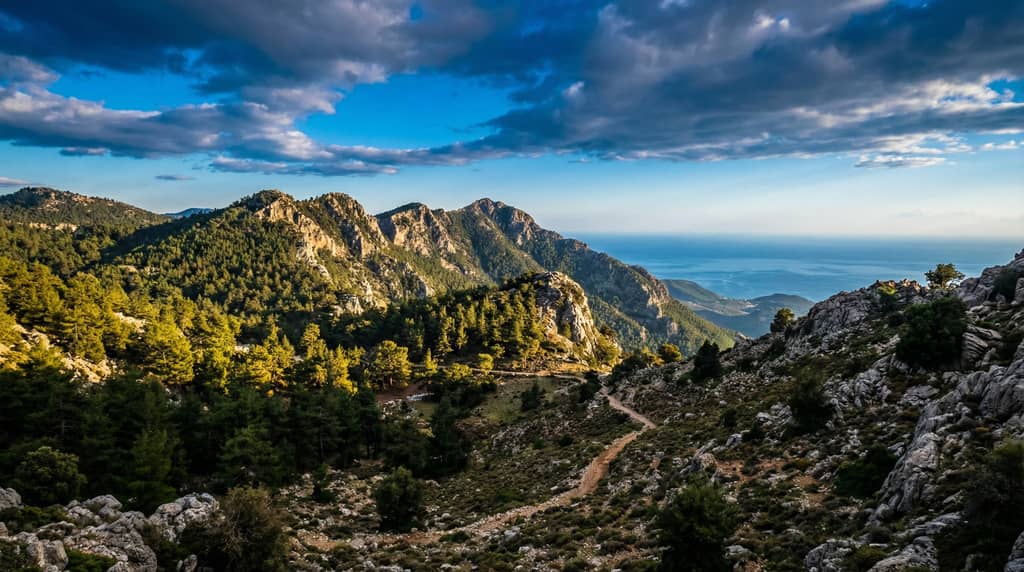
However, in recent years the “St. Paul Trail” has grown in popularity: a long-distance walking route of approximately 400 kilometres that recreates part of his first missionary journey. This trail, marked with red and white waymarks, stretches from Perge, on the Mediterranean coast, to Antioch of Pisidia (near present-day Yalvaç), in the interior of the Anatolian peninsula.
This trail offers a spectacular hiking experience. It crosses the majestic Taurus Mountains, lush valleys, dramatic canyons and rural villages where Turkish hospitality is shown at its very best.
Yet beyond the physical challenge, the true value of the route lies in its evocative power. Each stage brings us closer to the places where Paul preached, suffered persecution and sowed the seeds of a faith that would change the world. It is a unique opportunity to read his epistles in the very settings that inspired them, giving the words a new and deeper dimension of meaning.
The route is dotted with first-rate archaeological treasures. Ancient cities such as Perge, with its Roman gates and colonnaded avenue, or Aspendos, with its extraordinarily well-preserved theatre, transport us back to the era of the Roman Empire. Further on, the trail leads to Adada, a Roman settlement lost among the mountains. Finally, it reaches the ruins of Antioch of Pisidia, where the apostle delivered one of his earliest and most important sermons.
To walk among these ruins is to feel history beneath your feet, to imagine the bustle of their streets and the revolutionary novelty of the message that echoed within their walls two millennia ago.
Stages of the St. Paul Trail
- First stage: Perge → Kurşunlu (13 km)
- Second stage: Kurşunlu → Akçapınar (29 km)
- Third stage: Akçapınar → Pednelissos → Kozan (20 km)
- Fourth stage: Kozan → Pednelissos → Pinargözü (21 km)
- Fifth stage: Beşkonak (Roman Bridge) → Selge (18 km)
- Sixth stage: Selge → Çaltepe (21 km)
- Seventh stage: Çaltepe → Değirmenözü (16 km)
- Eighth stage: Değirmenözü → Çukurça → Kesmeköy (21 km)
- Ninth stage: Kesmeköy → Kasımlar (18 km)
- Tenth stage: Tota Yaylası → Adada → Sağrak (23 km)
- Eleventh stage: Adada → Sipahiler → Serpilköy (28 km)
- Twelfth stage: Serpilköy → Eğirdir (37 km)
- Thirteenth stage: Eğirdir → Bağören (26 km)
- Fourteenth stage: Bağören → Barla (19 km)
- Fifteenth stage: Barla → Dikmen Çiftliği (22 km)
- Sixteenth stage: Kemer → Aşağıtırtar (21 km)
- Seventeenth stage: Aşağıtırtar → Sücüllü (31 km)
- Eighteenth stage: Sücüllü → Antioch of Pisidia (11 km)
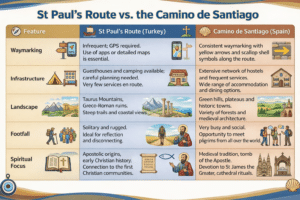
For pilgrims familiar with the various Jacobean routes, embarking on the Route of Saint Paul represents a different yet complementary experience.
Both pilgrimages share a deep spiritual core, but their characteristics and contexts offer contrasts that enrich the walker’s experience. While the Camino de Santiago is a tapestry woven from centuries of European Christian tradition, the Route of Saint Paul is a journey back to the very source, to the apostolic era where it all began.
One of the main differences lies in the infrastructure. Whereas the Camino de Santiago boasts a dense network of accommodation, constant waymarking and pilgrim-oriented services, the Route of Saint Paul is a more rugged and solitary experience. It requires greater planning in terms of accommodation —combining small guesthouses in villages, family-run lodgings and camping— and more attentive navigation, making the use of GPS highly advisable.
The landscape also offers a fascinating contrast. The green hills of Galicia or the plains of Castile find their counterpart in the rugged peaks of the Taurus Mountains and the serene beauty of Lake Eğirdir.
The cultural heritage is likewise different. While in Spain we encounter Gothic cathedrals and Romanesque monasteries, in Turkey the pilgrim is immersed in a world of Greco-Roman ruins, Byzantine basilicas and Ottoman mosques. Together, they bear witness to the many layers of history that make up the country.
Yet the spirit that animates both routes is the same. Personal challenge, the camaraderie that arises spontaneously among fellow travellers, the reflection encouraged by walking, and the connection with something greater than ourselves are universal elements of pilgrimage.
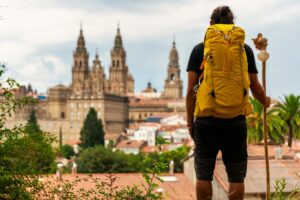
Those who have experienced the satisfaction of arriving at the Praza do Obradoiro after completing the Camino de Santiago from Gijón, or who have felt history beneath their feet while walking the Camino de Santiago from Logroño, will recognise that same emotion when contemplating the ruins of Ephesus at sunset. Likewise, the perseverance required to complete demanding stages, such as those found on the Camino de Santiago from Burgos, is the very same perseverance needed to ascend the peaks of the Taurus, forging a resilient character in the pilgrim.
Stages and must-see places on the Route of Saint Paul
Although the complete route is extensive, many pilgrims choose to walk specific sections or visit the most significant sites. Below, we highlight some of the places that no follower of the Apostle’s footsteps should miss:
Tarsus, the Apostle’s birthplace
The birthplace of Saul, present-day Tarsus is now a bustling Turkish city. Although few remains from the Roman period survive, visitors can see the “Well of Saint Paul”, an ancient well from a house traditionally associated with his place of birth. It is the emotional starting point of any Pauline pilgrimage.
Perge and Aspendos, the gateways to Pamphylia
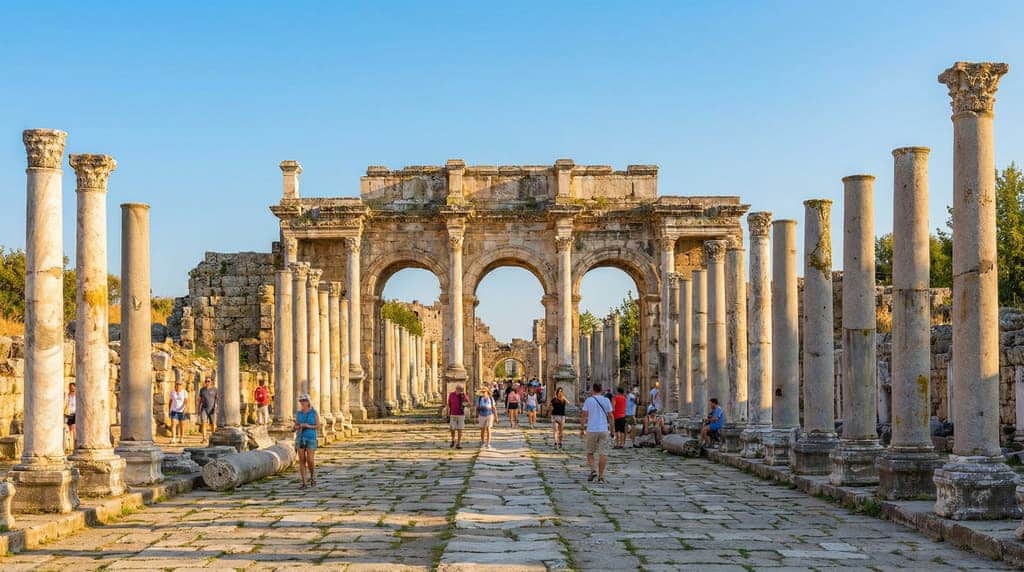
Perge is the official starting point of the St. Paul Trail. Its ruins, including a colonnaded avenue, a stadium and Roman baths, offer a magnificent introduction to the grandeur of the region’s Roman cities. Very nearby, the theatre of Aspendos, with its near-perfect acoustics and exceptional state of preservation, allows us to imagine thousands of citizens attending performances two millennia ago.
Antioch of Pisidia, the sermon that changed everything
Located near modern-day Yalvaç, this ancient city is one of the most important places in the history of early Christianity. It was here, in the local synagogue, that Paul delivered his first great sermon (Acts 13:14–41), explicitly opening the door of faith to the non-Jewish world for the first time. The ruins of the basilica built in his honour and the Roman aqueduct are deeply impressive.
Iconium, Lystra and Derbe: the heart of Lycaonia
These three cities, now within the modern province of Konya, were visited by Paul and Barnabas on their first journey. In Iconium (Konya), they preached with great success but also encountered strong opposition. In Lystra, Paul healed a lame man, leading the crowd to mistake them for the gods Jupiter and Mercury. These dramatic episodes come vividly to life when visiting the archaeological sites.
Ephesus, the metropolis of Asia Minor:
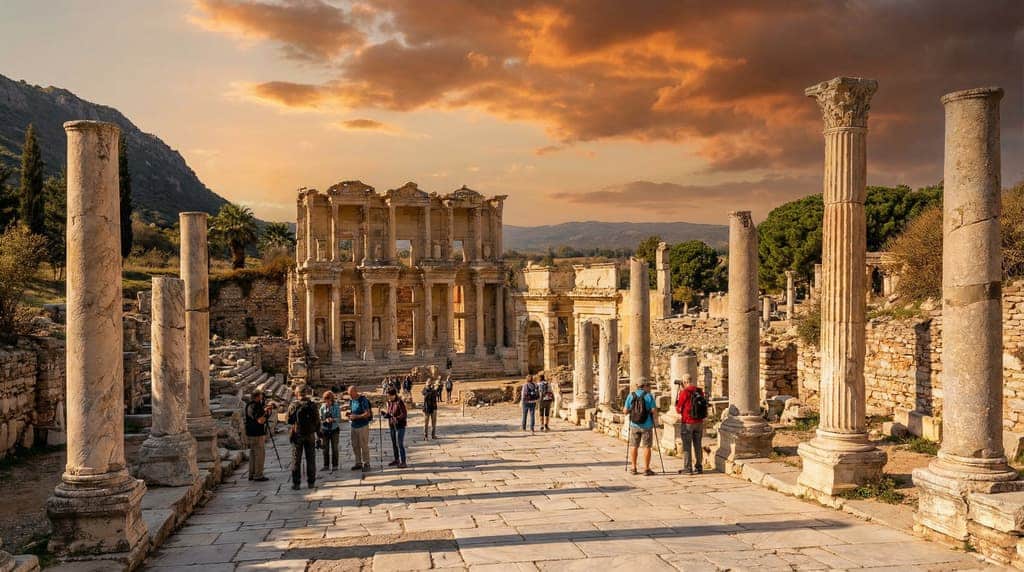
Although it does not strictly form part of the St. Paul Trail, Ephesus is an absolutely essential visit. Paul lived and preached here for almost three years during his third missionary journey. Walking along its marble street, admiring the imposing façade of the Library of Celsus, or sitting in the tiers of its vast theatre —where the silversmith Demetrius incited a riot against the Apostle— is one of the most memorable experiences Turkey has to offer.
Nearby, the House of the Virgin Mary, a pilgrimage site for both Christians and Muslims, adds a profound spiritual resonance to the visit.
The Seven Churches of the Apocalypse: a Pauline echo at the end of time
A pilgrimage through Asia Minor in the footsteps of Saint Paul finds a perfect and almost essential complement in the route of the Seven Churches of the Apocalypse.
These seven Christian communities were the recipients of the Book of Revelation, written by the Apostle John during his exile on the nearby island of Patmos. It is no coincidence that these churches were located in this region; their existence and vitality were largely a direct result of earlier evangelising efforts.
Each of these communities received a specific letter from John, containing praise, warnings and promises. Visiting their locations today adds a layer of eschatological and pastoral depth to the Pauline journey:
- Ephesus: the principal church, praised for its perseverance but warned for having lost its “first love”.
- Smyrna (Izmir): a persecuted community, encouraged to remain faithful unto death in order to receive the crown of life.
- Pergamum (Bergama): praised for its faith, but criticised for tolerating false doctrines within.
- Thyatira (Akhisar): recognised for its good works, yet rebuked for tolerating the prophetess “Jezebel”.
- Sardis (Sart): a church that had a reputation for being alive, but was in fact dead, and was urged to wake up.
- Philadelphia (Alaşehir): praised for its faithfulness despite little strength, with the promise of an open door that no one could shut.
- Laodicea (near Denizli): the famous “lukewarm” church, neither hot nor cold, rebuked for its material self-sufficiency and spiritual blindness.
To journey through these places is to witness the complete history of the early Church in Asia Minor, from the seed planted by Paul to the challenges and triumphs of subsequent generations, framed within the prophetic vision of Saint John. It is a fascinating dialogue between mission and perseverance, between the beginning of the path and the promise of the final destination.
Practical advice for pilgrims on the Route of Saint Paul
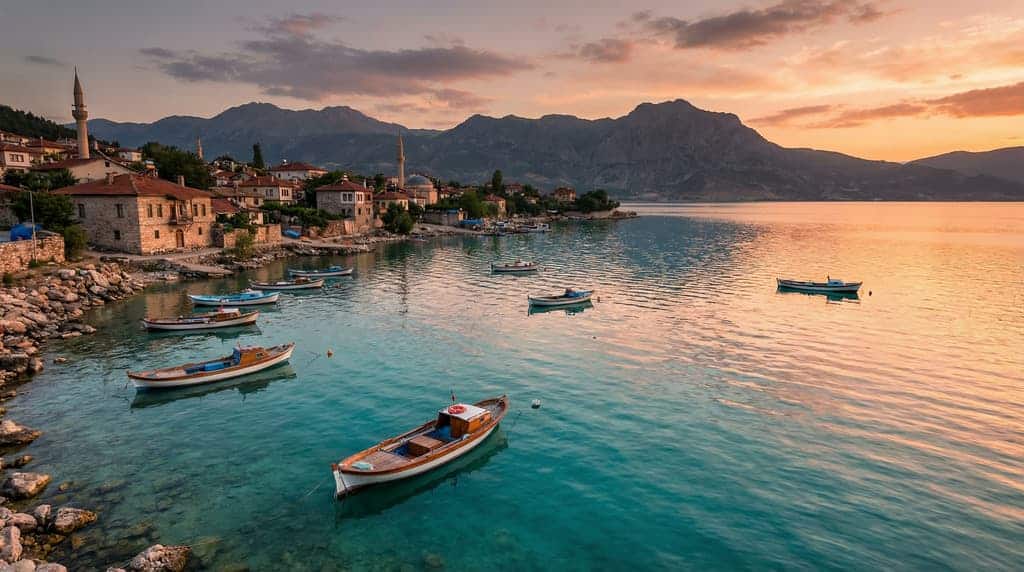
Undertaking the Route of Saint Paul requires more thorough preparation than other, more established pilgrimage routes. Here are some key tips to ensure your experience is both safe and rewarding:
- Best time to travel:
- Spring (April to June) and autumn (September to October) are, by far, the best seasons. Temperatures are mild and pleasant for walking, and the landscape is at its most beautiful, whether covered in wildflowers in spring or dressed in autumnal ochre tones.
- Summer can be extremely hot, especially in lower-altitude areas.
- Winter brings snow and cold to the mountains, making many sections difficult to pass.
- Essential equipment:
- Proper footwear: sturdy, well-broken-in hiking boots are essential. The terrain is varied and often rocky.
- Navigation: do not rely solely on waymarking. It is vital to carry a GPS device with the route tracks, a mapping app on your phone and, if possible, a map and compass as backup.
- Layered clothing: mountain weather can change rapidly. Dress in layers so you can adapt easily to temperature variations.
- Water and food: water sources and places to buy food are scarce on many stages. Plan carefully and always carry more water than you think you will need.
- Accommodation: book in advance at small village guesthouses. If you plan to tackle the more remote sections, you will need to carry a lightweight tent and a sleeping bag.
- Safety and culture:
- Shepherd dogs: in rural areas it is common to encounter livestock guardian dogs. They are usually large and intimidating. The recommendation is not to approach the animals, to move calmly and avoid sudden movements. If a dog approaches barking, remain calm and slowly move away without turning your back.
- Hospitality: the Turkish people are renowned for their hospitality. You may well be invited to share a tea (çay) in villages. Accept with a smile; it is a wonderful opportunity to engage with local culture.
- Respect: Turkey is a predominantly Muslim country. Dress modestly, especially when visiting mosques. Learning a few basic words in Turkish, such as “merhaba” (hello) and “teşekkür ederim” (thank you), will be greatly appreciated.
A journey that transforms
The Route of Saint Paul is far more than a simple long-distance trek. It is a pilgrimage in the deepest sense of the word: a journey that draws us out of our comfort zone and immerses us in a physical and historical landscape of overwhelming richness. It is walking along Roman roads that once felt the footsteps of the Apostle, gazing at the stars in the silence of the Taurus Mountains, and sensing a connection with two millennia of faith history.
This route offers a perfect counterpoint to other great pilgrimage paths. It is an invitation to adventure, introspection and the discovery of the foundations upon which Christianity was built. Ultimately, it is an opportunity to follow in the footsteps of a giant of history and, in the process, to find ourselves. A journey that will undoubtedly leave an indelible mark on the soul of anyone who dares to undertake it.