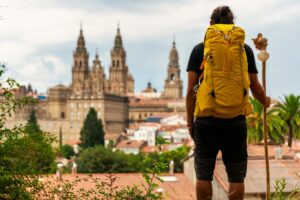
The Luso-Galician Marian Route is a spiritual itinerary that links northern Portugal with Galicia, connecting numerous sanctuaries dedicated to the Virgin Mary. It stretches for around 400 kilometres, crossing the provinces of Pontevedra and A Coruña to join the main Marian sanctuaries between Braga (Portugal) and Muxía (Galicia).
Created only a few years ago on the initiative of local Galician and Portuguese associations, this pilgrimage route offers an alternative and complementary option to the traditional Camino de Santiago. In fact, it has earned the nickname of “the other great pilgrimage route” between Galicia and Portugal, reflecting its growing regional importance.
Below we explore its history, its stage-by-stage route and the infrastructure available.
Índice de contenidos
- 1 Historical origin and meaning of the Marian Route
- 2 The route: from Braga (Portugal) to Muxía (Galicia) in 18 stages
- 2.1 Braga: Sameiro and Sé Cathedral
- 2.2 Alto Minho and the Sanctuary of Peneda
- 2.3 Crossing into Galicia via Melgaço–Arbo
- 2.4 Pontevedra: Sanctuary of A Franqueira
- 2.5 O Suído and Augasantas (Cotobade)
- 2.6 Moraña and A Estrada: Os Milagros
- 2.7 A Coruña: the Ulla region and A Escravitude
- 2.8 Santiago de Compostela: Virxe do Portal
- 2.9 Towards the Costa da Morte: Negreira and Muxía
- 2.10 Ending in Muxía: Sanctuary of the Virxe da Barca
- 3 Signposting and infrastructure for pilgrims
- 4 The Marian Route compared with other pilgrimage routes
Historical origin and meaning of the Marian Route
Devotion to the Virgin Mary in Galicia and northern Portugal is very ancient, even older than devotion to the Apostle James in the region. Numerous chapels and Marian sanctuaries have stood here for centuries, serving as centres for traditional local pilgrimages.
In the late 2010s the idea emerged of creating a long-distance trail that would revive and unite these ancient paths between the chapels. The project was driven by experienced promoters of Galician-Portuguese Jacobean routes (Luis do Freixo and José Antonio de la Riera, among others) with the aim of offering a different pilgrimage, centred on Mary rather than James.
The Marian Way was conceived outside the official network of Camino de Santiago routes, with its own identity, symbols and signposting. It does not seek to reinvent a historic path, but to link various sanctuaries in a new spiritual journey. Nevertheless, its creators have respected traditional routes (old cart tracks and footpaths), ensuring continuity with journeys already taken by devout villages.
The initiative came to fruition with the official opening of the route in 2019. It also introduced pilgrim credentials and even a Marian Certificate awarded upon completing the route. Today, it has the backing of associations and municipalities from both regions, who even aspire for it to be recognised as a future European Cultural Itinerary.
The route: from Braga (Portugal) to Muxía (Galicia) in 18 stages
The route extends for roughly between 370 and 400 km, divided into 18 walking stages or days.
- Stage 1: Braga → Goães (Vila Verde) — ≈ 21 km
- Stage 2: Goães → Ponte da Barca — ≈ 17 km
- Stage 3: Ponte da Barca → Soajo — ≈ 20 km
- Stage 4: Soajo → Sanctuary of Nossa Senhora da Peneda — ≈ 15 km
- Stage 5: Peneda → Melgaço — ≈ 18 km
- Stage 6: Melgaço → Arbo → Sanctuary of A Franqueira (A Cañiza) — ≈ 22 km
- Stage 7: A Franqueira → Covelo → Fornelos de Montes — ≈ 19 km
- Stage 8: Fornelos → Serra do Suído → Sanctuary of Augasantas (Cotobade) — ≈ 23 km
- Stage 9: Augasantas → Moraña → Sanctuary of Os Milagros de Amil — ≈ 18 km
- Stage 10: Amil → A Estrada (Chapel of Os Milagros de Requián) — ≈ 16 km
- Stage 11: A Estrada → Padrón → Church of Nosa Señora da Escravitude — ≈ 24 km
- Stage 12: Escravitude → Santiago de Compostela (Virxe do Portal) — ≈ 18 km
- Stage 13: Santiago → Negreira — ≈ 21 km
- Stage 14: Negreira → Olveiroa — ≈ 33 km
- Stage 15: Olveiroa → Cee — ≈ 18 km
- Stage 16: Cee → Fisterra — ≈ 16 km
- Stage 17: Fisterra → Lires — ≈ 14 km
- Stage 18: Lires → Muxía (Sanctuary of the Virxe da Barca) — ≈ 15 km
Braga: Sameiro and Sé Cathedral
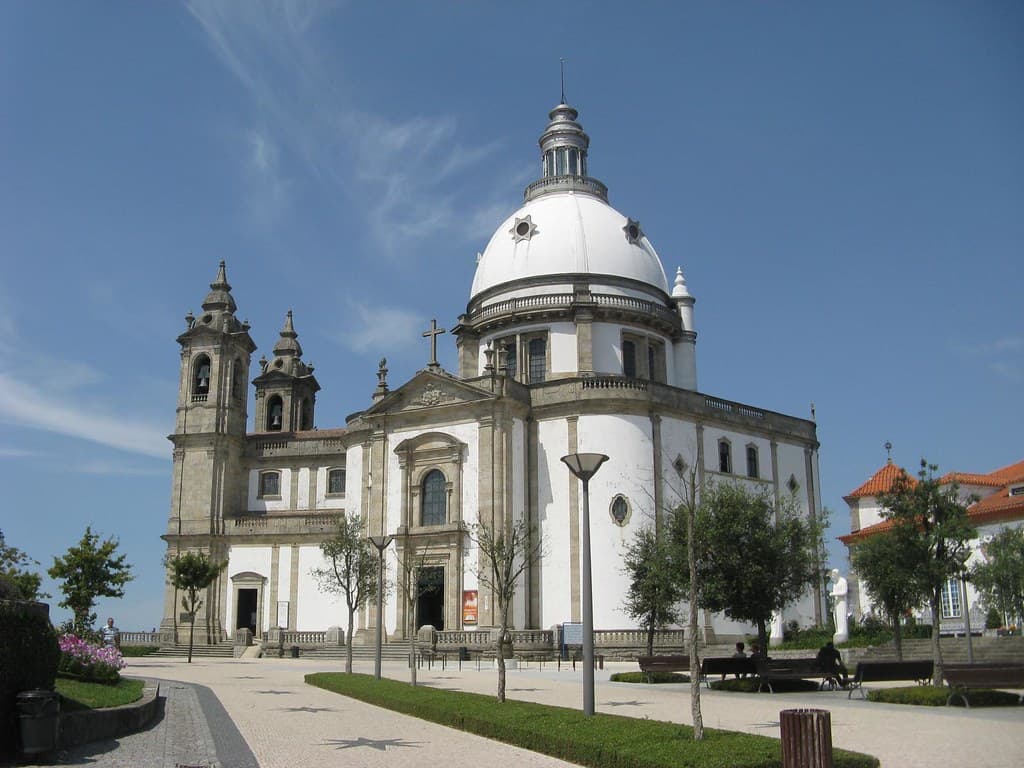
The starting point is the city of Braga, one of the oldest Christian cities in Portugal, renowned for its religious heritage. Here stands the Sanctuary of Nossa Senhora do Sameiro, the country’s second most important Marian sanctuary (after Fátima) and the first landmark of the Marian Way.
Also in Braga, the route visits the historic Sé Cathedral (the oldest cathedral in Portugal) before heading towards the rural interior of the north.
Alto Minho and the Sanctuary of Peneda
The route passes through several Portuguese towns and natural landscapes, stopping in small villages and sanctuaries. For instance, it traverses the region of Alto Minho, passing through places such as Goães (Vila Verde), the town of Ponte da Barca, Soajo (in the Peneda-Gerês National Park), and finally reaches the Sanctuary of Nossa Senhora da Peneda.
This sanctuary is set high in the mountains and very close to the border. It is striking for its location beneath a massive granite outcrop and for its imposing Baroque staircase of nearly 300 steps leading up to its façade.
Crossing into Galicia via Melgaço–Arbo
After venerating the Virgin of Peneda, pilgrims head towards Melgaço, the last Portuguese town, where they cross the River Miño by the Arbo-Melgaço international bridge to enter Galicia.
Pontevedra: Sanctuary of A Franqueira
Once in Galicia, the first major stage takes pilgrims to the Sanctuary of A Franqueira (A Cañiza). This is one of the most popular Marian temples in Galicia, famous for its large pilgrimages and for housing a very ancient image of the Virgin of A Franqueira, dating back to around the 6th century.
O Suído and Augasantas (Cotobade)
The route then crosses the inland regions of Pontevedra: it passes near Covelo and Fornelos de Montes, climbs up to the Suído mountain range and descends to the Sanctuary of Santa María de Augasantas (Cotobade). Many of these sanctuaries are linked to ancient legends of apparitions or miraculous springs (as in the case of Augasantas, whose name refers to “holy waters”).
Moraña and A Estrada: Os Milagros
The journey continues through fertile valleys and rural hamlets: in the municipality of Moraña, for example, the route passes by the Sanctuary of Os Milagros de Amil, another very popular pilgrimage centre, with its main festivity in September. Not far away, in A Estrada, stands the chapel of Os Milagros de Requián, which shares the same devotion and is also part of the itinerary.
A Coruña: the Ulla region and A Escravitude
Later, the route enters the province of A Coruña for its final stages. At this point, the path leads towards the Ulla river region, connecting with landmarks such as the Church of Nosa Señora da Escravitude (in Padrón). This 18th-century Baroque church, located in the parish of Santa María de Cruces, lies just a short distance from the traditional Portuguese Way.
Santiago de Compostela: Virxe do Portal
The city of Santiago de Compostela is also part of the Marian Route, though in this case it is not the end but rather another stage in the pilgrimage. Here, the route stops at the convent church of the Virxe do Portal, a small sanctuary not far from the Cathedral itself.
Towards the Costa da Morte: Negreira and Muxía
From here, pilgrims continue on their way following in the footsteps of those heading to Fisterra-Muxía: the itinerary takes the same route as the Jacobean extension towards the Costa da Morte. Crossing forests and villages in deepest Galicia, the penultimate stage usually leads to the vicinity of Negreira or further on, before finally heading towards the Atlantic coast in the direction of Muxía.
Ending in Muxía: Sanctuary of the Virxe da Barca
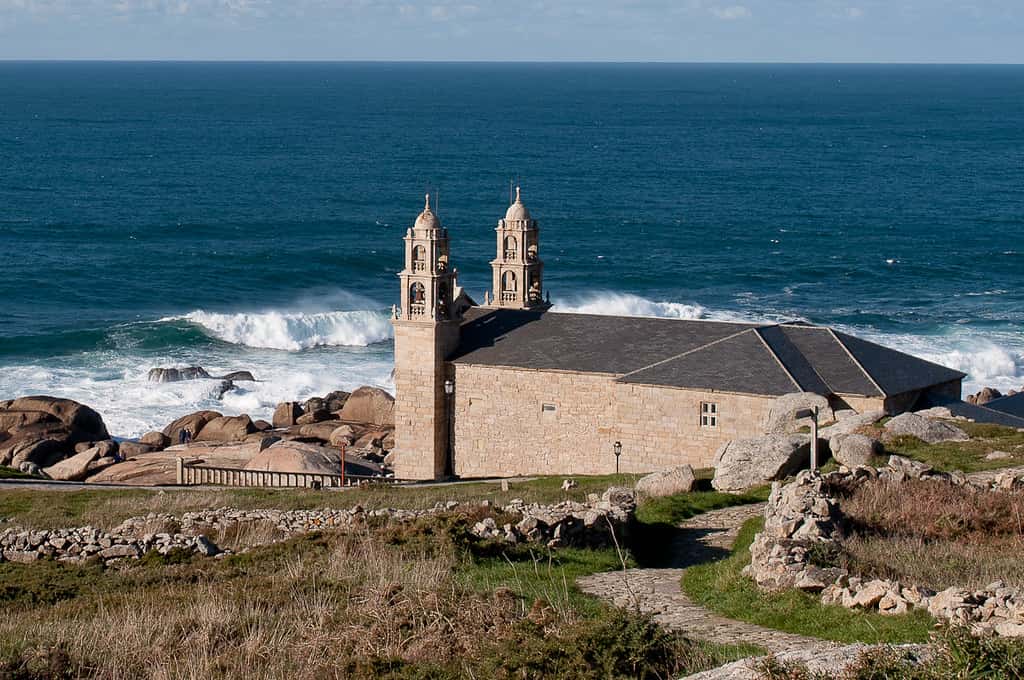
The Santuario da Virxe da Barca in Muxía marks the end of the Vía Mariana. This temple, one of the most impressive in Galicia thanks to its location by the sea, stands on a rocky headland where tradition places the miraculous apparition of the Virgin Mary to St James the Apostle. The present church dates from the 18th century and has been a centre of veneration since medieval times.
Natural and cultural heritage along the way
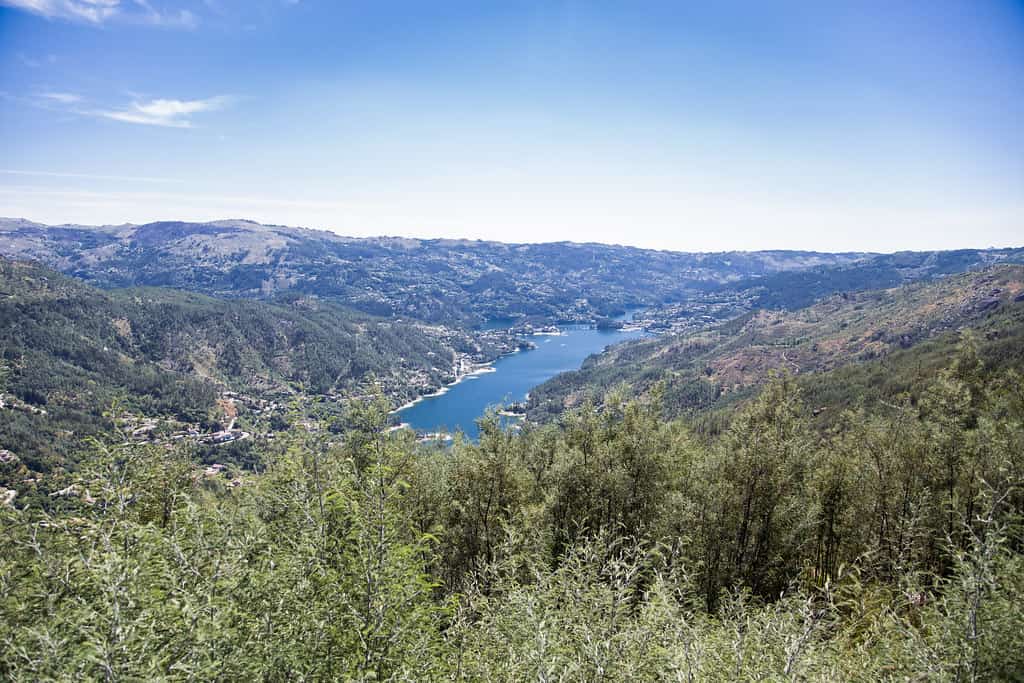
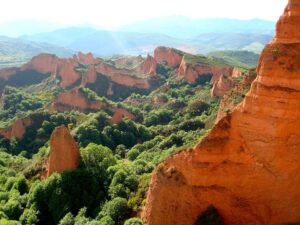
One of the great attractions of the Luso-Galician Marian Route is the landscape and heritage richness it offers throughout the journey. Unlike some of the Camino de Santiago routes that pass through urban or industrial areas, this path mainly runs through rural settings and well-preserved natural spaces.
In Portugal, the route crosses the Peneda-Gerês National Park, with its native forests, river valleys and beautiful mountain scenery. Once in Galicia, the route passes through mountain ranges and lush woodlands (O Suído, Covelo mountains, etc.), traditional farming valleys and areas of high ecological value.
Contact with nature is constant: waterfalls, rivers such as the Miño, the Deva or the Ulla, fragas (Atlantic forests) and panoramic viewpoints make the journey a particularly green and peaceful experience for the pilgrim.
Alongside its natural wealth, the historical and cultural heritage of the route is equally significant. In addition to the sanctuaries and chapels themselves –ranging from small rural hermitages to basilicas of great artistic value– the pilgrim comes across numerous ethnographic and historical elements along the way.
Ancient stone bridges, medieval roads, cruceiros (typical Galician stone crosses), petos de ánimas (small altars for souls), holy springs, hórreos (granaries), traditional washhouses and villages with vernacular architecture line the route.
Each section offers opportunities to discover local legends, religious traditions (pilgrimages, processions), as well as the gastronomy and warm hospitality unique to each area.
Signposting and infrastructure for pilgrims
Although more recent and less crowded than the classic Jacobean routes, this itinerary has gradually developed a basic infrastructure to welcome pilgrims.
Since 2018–2019, specific signposting has been put in place along the entire trail: the route has its own symbol and markers (different from the yellow arrow of the Camino de Santiago) to guide walkers. Local associations, councils and community landowners have collaborated in reopening abandoned paths and improving difficult sections.
Today, much of the route is marked with distinctive posts and plaques of the Vía Mariana, making it easy to follow without the need for a GPS device.
As for accommodation, since this is an emerging route, the network is still limited but steadily growing. Several pilgrim hostels have been set up along the way, often making use of existing buildings or through agreements with municipal facilities. Even in the Santuario da Peneda itself, space has been prepared for pilgrims.
In Muxía, at the end of the route, pilgrims can request the so-called Marian Certificate, equivalent to a “compostela”, which certifies completion of the pilgrimage (currently issued at the local tourist office). For this, there is a pilgrim’s credential in which stamps from the sanctuaries visited are collected, just as on the Jacobean routes.
It is worth noting that the number of pilgrims is still small compared to the traditional Camino de Santiago. This means that travellers need to plan their stages with a little more foresight, considering the distances between services, food and accommodation available in each village.
The Marian Route compared with other pilgrimage routes
Within the wide range of pilgrimage routes on the Iberian Peninsula, it holds a special place. It is not a “Camino de Santiago” in the usual sense, since its ultimate goal is not the Apostle’s tomb but to visit various Marian shrines. Nevertheless, Santiago de Compostela forms part of the itinerary and, in fact, both routes share certain stretches and spiritual symbolism.
As already mentioned, pilgrims on the Vía Mariana also walk through Galicia carrying a credential and collecting stamps at each stage. They can even continue along the Jacobean extension to Fisterra and Muxía.
Differences with each route
Each pilgrimage route has its own charm and particular features.
- The Northern Way follows a maritime route along the Cantabrian and Asturian coasts. On the section of the Northern Way from Santander to Gijón, for example, pilgrims walk through landscapes of beaches, cliffs and fishing villages.
-
- The Marian Route, by contrast, runs through inland Galician-Portuguese landscapes, with isolated hills and valleys. In other words, it offers greater contact with the rural countryside than some coastal routes.
- With the Portuguese Way the link is even closer, as both routes run south to north, connecting Portugal with Galicia. The Vía Mariana runs roughly parallel, a few kilometres further east, to the central Portuguese Way.
-
- While the main Portuguese route enters Galicia via Tui, or its coastal variant through A Guarda, the Vía Mariana enters via Arbo, further inland.
However, the geographical proximity between the two routes (especially in the coastal variant) makes it possible to combine sections.
- For instance, a pilgrim might first follow the Portuguese Way from Porto to A Guarda –enjoying the Atlantic scenery and fishing towns–. Once in A Guarda, they could move a few kilometres inland to link up with the Vía Mariana in the Pontevedra area. Of course, they could also continue along the Way from A Guarda to Santiago de Compostela.
It is worth highlighting that the Vía Mariana coincides partially with existing Jacobean routes at certain points: for example:
- On the stage from Padrón to Santiago many Marian pilgrims walk alongside those on the traditional Portuguese Way. The church of A Escravitude is very close to the Jacobean route.
- From Santiago to Muxía, the Marian Route follows the same trail as the Jacobean extension to Fisterra/Muxía for many kilometres. In this sense, rather than competing, the Marian Route complements the Camino de Santiago experience. It brings a different devotional focus (centred on the Virgin Mary) and reveals hidden corners to the walker.
Finally, it is relevant to mention the role of specialised agencies working around pilgrimages. The surge in popularity of the Camino de Santiago in recent decades has led to the rise of companies that help pilgrims with planning and logistics. These private initiatives can be a valuable support for those seeking extra comfort along their route.
Indeed, Mundiplus, your Camino de Santiago agency, offers services such as accommodation booking, luggage transfer and personalised tourist information on the traditional Caminos de Santiago. In the case of the Marian Route, as it is relatively new, there are still few operators including it in their packages, but it is expected that over time the range of services will increase for this alternative path.
In short, the Luso-Galician Marian Route is presented as a unique pilgrimage path, bringing together two sister regions around the figure of the Virgin Mary. With its blend of spirituality, historical heritage and natural beauty, this route offers an enriching alternative for exploring Galicia and Portugal beyond the usual trails.