Embarking on the Camino de Santiago is one of the most enriching and transformative experiences a traveller can have. The call of the Jacobean route draws hundreds of thousands of people from all over the world each year, each with their own motivations and expectations. However, beyond physical and mental preparation, one of the most common questions among future pilgrims is: how much does this adventure really cost?
The answer is not straightforward, as the budget can vary depending on the style of travel chosen. Far from the traditional image of the pilgrim on a tight budget, sleeping only in public hostels, there is a much more comfortable and planned way to experience the Camino—one that focuses on comfort, safety, and peace of mind.
This guide is designed for pilgrims seeking an organised experience, without sacrificing the essence of the Camino, while prioritising good rest, smooth logistics, and quality services. The aim is to demystify the notion that the Camino is only for backpackers and to show that it is accessible to everyone, regardless of age or physical condition.
We will analyse in detail each of the costs involved in planning the Camino de Santiago so that you can create a realistic budget and focus on what matters most: enjoying the journey, connecting with the surroundings, and living an unforgettable experience.
Índice de contenidos
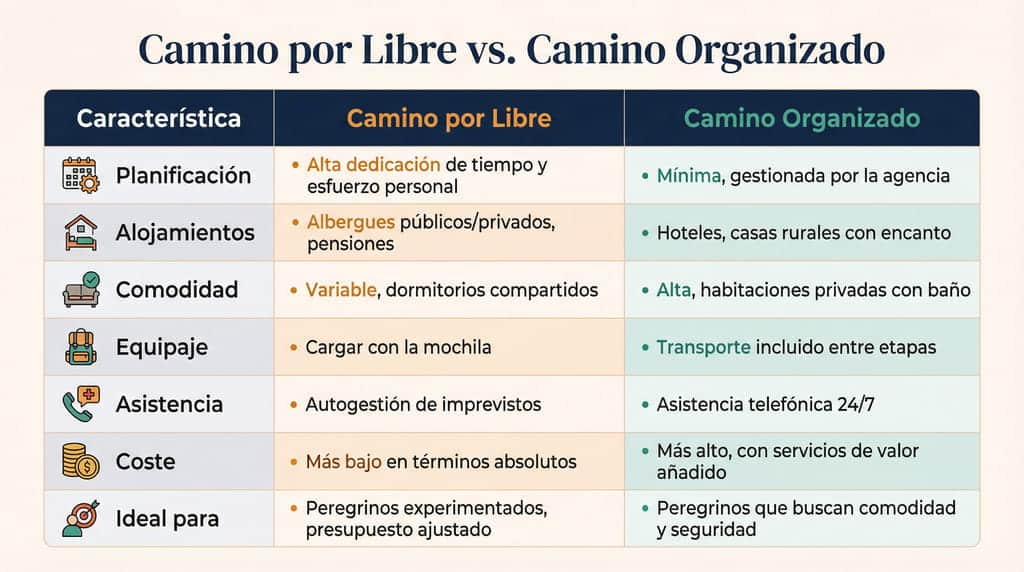
The big difference: Independent Camino vs. Organised Camino

Before breaking down the numbers, it is essential to understand the two main pilgrimage options and why their costs differ so much. Choosing between travelling the Camino independently or in an organised way is the first major decision that will define not only your budget but also your overall experience.
Independent
Travelling independently means the pilgrim manages every detail personally: booking accommodation (often months in advance, especially during peak season), finding daily meals, handling luggage, and solving any unexpected issues that may arise.
While it may be cheaper in absolute terms, it requires a considerable investment of time and effort. The uncertainty of not knowing where you will sleep the next night can create stress that diminishes the spiritual and disconnecting experience many seek. Additionally, during peak season, accommodation options are more limited, forcing you to walk longer distances than planned or to seek last-minute alternatives at higher prices.
Organised Camino
An organised Camino de Santiago entrusts all logistics to an expert agency. This not only frees the pilgrim from planning stress but also guarantees a high standard of quality in all services.
This means staying in charming hotels and rural houses, enjoying private rooms with bathrooms, having luggage transported each morning, and receiving assistance along the route. This comfort has a value beyond the simple economic cost. It is about buying peace of mind and the assurance that each day will end with restful sleep, allowing you to focus on the landscape, introspection, and connecting with other travellers.
Budget breakdown for an organised Camino de Santiago in 2026

To provide a clear and precise overview, we have structured the budget into several key categories. The prices presented are estimates based on current 2025 rates and projections for 2026, and may vary slightly depending on the season (high, mid, or low) and the specific route chosen.
It is important to note that the high season, which includes the summer months and coincides with the Jacobean Holy Year, usually involves an increase in accommodation prices.
1. Organised service package: the heart of your budget
The main cost of your trip will be the package booked with the agency. This price covers the essential services that ensure your comfort and safety. The cost varies mainly depending on the route and its duration. Longer routes or those with more challenging terrain may be slightly more expensive. The choice of route not only defines the landscapes that will accompany you but also the required investment.
For concrete reference, below are the approximate prices of some of the most popular organised Camino de Santiago sections offered by Mundiplus. These prices reflect a high standard of quality, with accommodation selected for its charm and service.
| Route (Section) | Duration | Kilometres | Approximate Price per Person (Double Room) |
| French Camino from Sarria | 6 days / 5 nights | 115 km | €595 |
| French Camino from Logroño | 7 days / 6 nights | 125 km | €595 |
| French Camino from Burgos | 11 days / 10 nights | 181 km | €895 |
| Northern Camino from Gijón | 9 days / 8 nights | 140 km | €850 – 950 (Enquire) |
| Portuguese Camino from Tui | 6 days / 5 nights | 118 km | €620 |
| Camino from Roncesvalles to Logroño | 7 days / 6 nights | 145 km | €735 |
| Camino from O Cebreiro to Santiago | 8 days / 7 nights | 152 km | €795 |
What do these packages usually include?
It is important to know what you are paying for. A standard high-quality package generally includes a range of services designed to maximise comfort and minimise concerns:
- Accommodation in hotels, pazos, and rural houses: the selection of accommodation is a major differentiator. Priority is given to charming establishments with good gastronomy and excellent service. Always in private rooms with en-suite bathrooms to ensure privacy and rest. It is important to note that you will never stay in hostels with shared dormitories.
- Meal plan: at a minimum, daily breakfast is included, often a hearty breakfast designed to provide energy for the stage. Many agencies offer the option of half-board (breakfast and dinner), simplifying daily logistics and allowing you to enjoy local cuisine without worries.
- Luggage transport between stages: for many, this is the standout service. Each morning, you leave your suitcase at the hotel reception, and at the end of the stage, it will be waiting in your new room. This allows you to walk with a light daypack, carrying only the essentials for the day: water, a snack, a raincoat, and your documents.
- Information dossier and pilgrim credential: you will receive a detailed guide for your route, with maps, stage profiles, cultural information, and recommendations. You will also be provided with the official credential, which must be stamped at each stage to obtain the Compostela upon arrival in Santiago.
- 24-hour telephone assistance: an essential service to resolve queries, handle any unexpected situations, or coordinate emergency support if necessary. Knowing there is someone on the other end of the phone provides immense peace of mind, especially for first-time pilgrims or solo travellers.
- Travel insurance: all packages include basic travel assistance insurance covering medical or other eventualities during your pilgrimage. It is advisable to review coverage and, if necessary, extend it with cancellation insurance.
- Route assistance vehicle: in case of emergency or if you cannot complete a stage for any reason, a vehicle can pick you up and take you to your accommodation.
2. Living expenses: meals and drinks
Although breakfast is usually included, you should budget for lunch and dinner. This is where costs can become more personal. Along the Camino, you will find an exceptional gastronomic offer, from fine dining restaurants to traditional pilgrim menus, which are institutions in themselves. Food is a fundamental part of the experience, and each region you pass through offers its own specialties.
- Pilgrim’s Menu: remains a popular and economical option. For a price ranging from €12 to €18, you can enjoy a starter, main course, dessert, bread, and a drink. It’s a hearty choice, perfect for recharging your energy, and an excellent way to sample the local cuisine of each region.
- A la carte or small plates: if you prefer to explore local gastronomy with more freedom, the cost can rise to €25–40 per meal. This option allows you to discover more elaborate dishes and enjoy a fuller culinary experience, especially in cities like Logroño, Burgos, or León.
- Refreshments during the stage: it’s important to always carry water, some fruit, or nuts. Budget around €5–8 per day for these small purchases at local shops or for a mid-morning coffee in one of the many bars along the route.
Estimated daily budget for meals (lunch and dinner): Between €30 and €50 per person per day, depending on whether you choose set menus or an a la carte experience.
3. Transport: getting to the starting point and returning home
This is one of the most variable costs, as it depends entirely on your place of origin. Travelling from a nearby Spanish city is very different from flying in from another continent. You should consider:
- Flights or trains to the starting city: research in advance to find the best deals. The airports closest to popular starting points are Madrid (MAD), Barcelona (BCN), Bilbao (BIO), or Santiago de Compostela (SCQ). From there, you will need to connect to your starting point by train or bus.
- Buses or private transfers: from the airport or main station to the town where your Camino begins (e.g., Sarria, Roncesvalles, etc.). At Mundiplus, we offer this transfer as an optional service, which can greatly simplify your arrival, especially if your flight lands late or if the starting point is poorly connected.
- Return from Santiago: once the experience is complete, you will need to get back home. Santiago de Compostela Airport has good connections to major Spanish and European cities. Another option is to take a train or bus to Madrid or Barcelona and fly from there.
Estimated budget for national transport (round trip): between €80 and €200 per person. For international travellers, this cost can be significantly higher.
4. Equipment: the initial investment
While you don’t need professional mountaineering gear, investing in quality equipment is essential to avoid injuries and enjoy the experience. If you already hike regularly, you may already have much of the necessary gear. If not, here’s a basic list with approximate costs:
- Footwear: the most important item. A good pair of trekking boots or trail running shoes, already worn in to fit your foot, is vital. Don’t skimp here; your feet will thank you. It’s essential that the footwear is broken in before starting the Camino. (€100–180).
- Backpack: even though your main luggage is transported, you’ll need a small backpack (20–30 litres) for daily essentials (water, snacks, raincoat, first-aid kit, documents). (€40–80).
- Technical clothing: the key is breathability and quick drying. Invest in technical t-shirts, hiking trousers (preferably convertible to shorts), blister-preventing socks, a fleece for chilly mornings, and a good waterproof and breathable jacket (Gore-Tex or similar). (€150–300).
- Other accessories: trekking poles (highly recommended to reduce knee impact and assist on climbs), cap or hat, sunglasses, sunscreen, and a small first-aid kit with essentials (plasters, anti-inflammatories, foot balm). (€50–100).
Estimated budget for equipment (starting from scratch): between €300 and €600. Remember, this is a one-off cost that will serve for future adventures.
5. Additional and personal expenses
Finally, it’s always advisable to have a small buffer for unforeseen expenses or personal treats. This may include:
- Visits to monuments and museums: many churches and cathedrals charge an entry fee (€3–10). The Burgos Cathedral, for example, is a must-see.
- Souvenirs and keepsakes: from the iconic scallop shell to local crafts or gastronomic products.
- Laundry: even if you bring several days’ clothing, you may need to wash something. Some accommodations offer this service.
- Extra activities: an afternoon at a spa to recover your legs, a wine tasting in La Rioja, or a seafood feast upon arriving in Galicia.
Recommended budget for extras: Between €15 and €25 per day.
Estimated total budget for 2026: a practical example
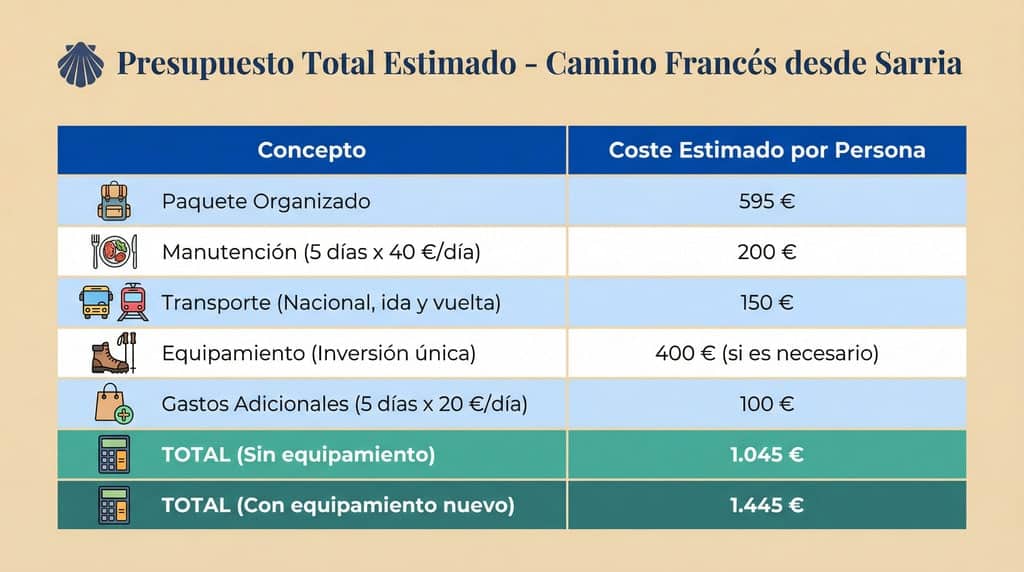
To consolidate all this information, let’s create a model budget for one of the most popular routes: the French Way from Sarria (6 days / 5 nights).
Tips to optimise your budget
Although an organised Camino involves a higher cost than going independently, there are ways to optimise your investment:
- Book in advance: many agencies offer discounts for early bookings. Mundiplus, for example, offers a €25 bonus for early reservations.
- Travel in the shoulder or low season: accommodation and flight prices are usually lower outside the summer months.
- Opt for half-board: if dinners are included in the package, you’ll save on meals and avoid the uncertainty of finding a restaurant each night.
- Share a room: if you travel as a couple or with friends, the per-person price in a double room is significantly lower than that of a single room.
- Reuse equipment: if you already have hiking gear, you don’t need to buy everything new. Check what you have and acquire only the essentials.
An investment in an unforgettable experience

As we’ve seen, the budget for completing the Camino de Santiago in an organised way can range, for a one-week route, between €1,000 and €1,500 per person, depending on whether you need to purchase all your equipment. While this cost is higher than an independent pilgrimage staying in hostels, the difference translates directly into peace of mind, safety, and comfort.
Choosing an organised trip allows you to disconnect from logistical stress and fully connect with the landscape, culture, and fellow pilgrims. It’s an investment in your well-being, ensuring that each stage ends with a well-deserved rest in a cosy place, and that your only concern is putting one foot in front of the other. In the end, the value of memories, friendships forged, and personal achievement far outweighs any number in a budget.
The Camino awaits, and planning it wisely is the first step to living an adventure you’ll remember for a lifetime.