Indicates the number of persons
Full and customizable services for a worry-free experience on the Wey of Santiago.
Accommodations in Hotels, Rural Houses, Hostels
Rooms with private bathroom.
Special breakfast
Travel assistance insurance in Spain
Roadside assistance vehicle in case of emergency
Roadside telephone assistance
Luggage transfer at the stages
✓ 1 suitcase per person, maximum 20kg
Digital information dossier of the path
Special gifts, including the Pilgrim's Credential, the Pilgrim's Scallop, and a typical Galician product.
No cancellation fees
✓ Up to 10 days before starting the Camino
IVA
Single room supplement
✓ Consult
Dinner supplement
✓ Consult
Extra night in Santiago
✓ Consult
Additional luggage
✓ Check rates if you have more than 1 bag per person
Replace the Caldas de Reis-Padron Stage
✓ Make translatio (Boat+foot)
Day Trips (Bus)
✓ Finisterre (Costa da morte) and/or Rias Baixas.
Cancellation Insurance
Remember that the cost of the optional services chosen will be added to the base price of your route. We are committed to making your pilgrimage an unforgettable and carefree experience. Welcome to the Wey!
Discover the Wey of Santiago towards the majestic Santiago de Compostela.
Welcome to the beginning of your journey. Get ready for an unforgettable adventure!
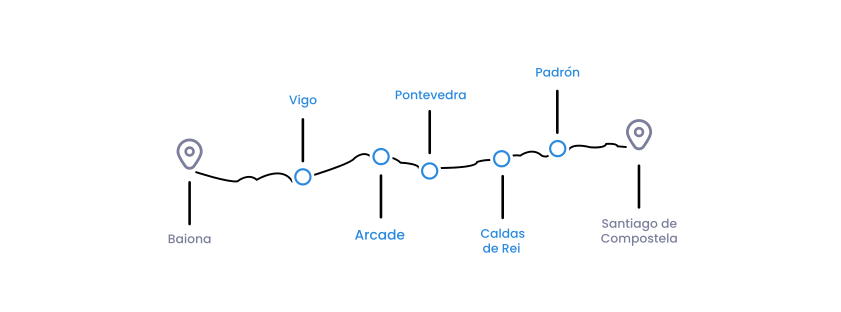
Breakfast and start of the first stage of the Camino de Santiago from Bahia.
At the exit of Baiona, we will cross the Miñor River, through the Romanesque Bridge of Ramallosa, to then enter the Ría de Vigo. Along the Camino we will find numerous Pazos and wooded areas, quite leafy, from which we can observe in the distance the Cies Islands, as well as the Cruceiros de Mallón and O Pereiro.
In the vicinity of Vigo, we will walk the path of the Lagares River, Castrelos Park and the Pazo de Quiñones de León, to finish in Vigo, the most populous city in Galicia.
Arrival in Vigo. Lodging.
Breakfast and start of the stage.
Once we leave Vigo, the Way runs parallel to the coast until reaching Arcade.
We will travel this stage, through the Senda da Traida das Augas, from the exit of Vigo, at its beginning, to the middle of the stage, practically, with the lookout set, in the distance in the Cies Islands, as well as the Puente de Rande and the Ensenada de San Simón.
From Redondela, The route joins the one that links with the Central Portuguese Way. From here, We walk towards the town of Cesantes, with permanent views of the Vigo estuary, to reach Arcade, famous for its well-known oysters and excellent restaurants where you can taste its seafood, putting an end to our stage today.
Arrival at Arcade. Lodging.
Breakfast and start of the stage.
Short and well-marked stage. It does not present any major difficulties.
We highlight the medieval bridge of Pontesampaio, which is located at the exit of Arcade, famous for an important battle in the War of Independence, where the French troops were defeated and meant their withdrawal from Galicia). We have to be careful, because before entering Pontevedra, we have to take the river path of Rio do Gafos, just after the chapel of Santa Marta, a pleasant walk that will put us at the gates of Pontevedra.
Arrival in Pontevedra. End of the stage. Lodging.
Breakfast and start of the stage.
After the monumental Pontevedra, we enter right into small towns in deep Galicia that will transport us and take us away from the mundane noise of the big cities.
Caldas de Rei and its hot springs will be the culmination of the stage.
Llegada a Caldas de Rei. End of the stage. Lodging.
Breakfast and start of the stage.
Easy stage, where silence abounds, and which leads us to relax and meditate on the experience of the trip.
Arrival in Padrón. End of the stage. Lodging.
Spiritual Variant-Translatio
If you want your Camino to be even more complete, a boat can take you from Vilanova de arousa to Pontecesures, and then make 2.5 Kms on foot to Padrón where we will accommodate you.
Breakfast and start of the stage.
After our stay in Padrón and Iria Flavia, places of great Jacobean evocation – according to legend, here the boat ran aground with the remains of the Apostle, coming from Palestine, in a “Pedrón”, which is preserved in the cathedral of that city, we are on our way to the end of our Way.
Stage of asphalted tracks, where we lose the mysticism and the bucolic atmosphere of the past days, which will partially darn out of our stage until the arrival at the spectacular Cathedral of Santiago.
Arrival in Santiago de Compostela. End of our Camino de Santiago from Baiona. Lodging.
We’re coming to the last day of your trip! Enjoy breakfast and conclude this unforgettable experience with us.
Thank you for being part of this adventure!
This itinerary will take you through the most popular stages, allowing you to experience the beauty and culture of the Wey of Santiago. Be sure to book accommodation in advance, as it can get crowded, especially in the high season.
Safe travels and buen Wey!
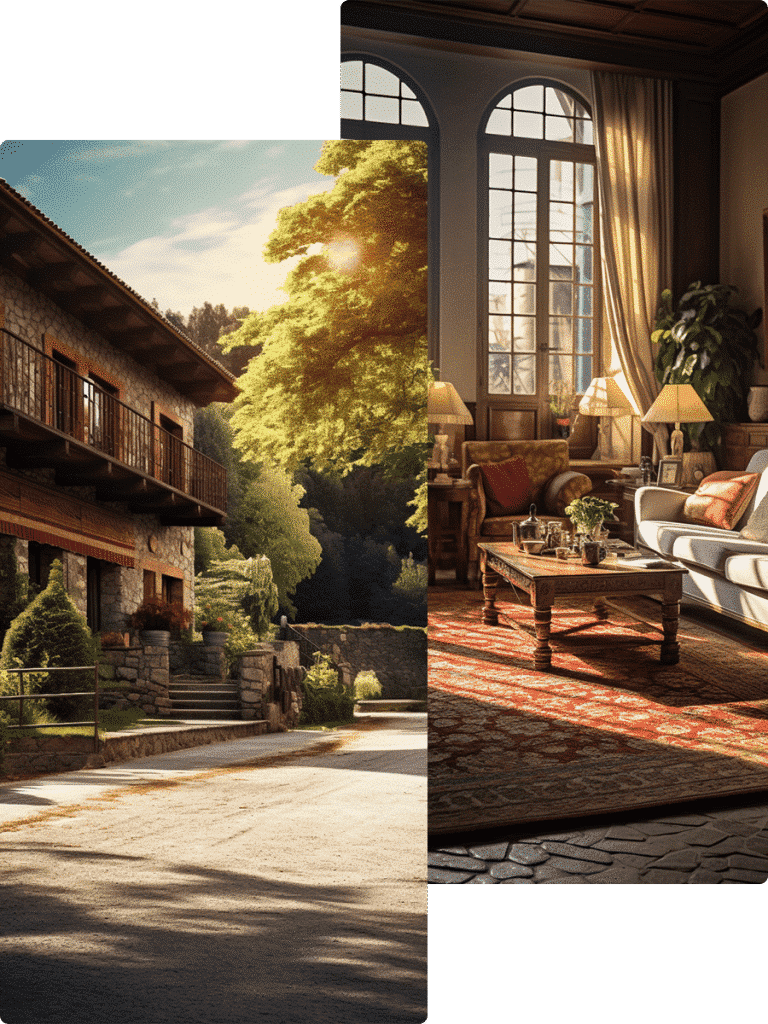
In our constant effort to provide the best experience to our customers, we want to assure you that we are committed to your rest and comfort. The accommodations we offer have been carefully selected and provide private rooms with private bathrooms, along with all the necessary services to make the most of your stay. It is important to note that we will never put you up in hostels.
Since these accommodations have a limited capacity, we will provide you with the exact name once you confirm your reservation and we verify availability on the dates of your choice. Your satisfaction is our priority!
In 1745, Friar Martín Sarmiento, a Dominican monk of Galician origin, returned from Madrid to his beloved homeland to embark on a pilgrimage to Santiago de Compostela. He documented his journey along the coastal line between Pontevedra and Padrón in his work “Viaje a Galicia” (Journey to Galicia).
Internationally recognized for its hospitality, cuisine, and wines, each municipality welcomes the pilgrim with the best accommodation options and a gastronomy of sea and land based on locally sourced, extremely fresh products, prepared in innovative or traditional ways.
Its wines deserve a separate chapter. As the territory of Albariño par excellence, Salnés is the area with the largest concentration of vineyards and wineries in the Rías Baixas Designation of Origin.
We provide you with different options on how to get to your organized Way of Saint James starting from the city of Pontevedra.
Option 1: Private car and leave the vehicle parked in Pontevedra.
Option 2: Bus.
Santiago y Vigo>Pontevedra
– From Santiago to Pontevedra with the Monbus company.
– From Vigo to Pontevedra with the Monbus company.
Madrid and Barcelona> Vigo
– From Madrid to Pontevedra with the Avanzabus company.
– From Barcelona to Pontevedra with the Monbus company.
Option 3: Train (Renfe)
Option 4: Airplane
The closest airports to Pontevedra are Santiago and Vigo.
From here, there are two possibilities to reach Pontevedra:
– By bus, option seen previously.
– Private transfer: pick-up at Santiago/Vigo airport and direct transfer to the hotel in Tui. Please ask us for the price of the service.
Sanxenxo, often called the Marbella of the North, is one of the best destinations in all of Galicia, a lively town in July and August when many tourists come mainly from all over Spain to enjoy their summer vacations.
Like other destinations overlooking the Ría de Pontevedra and towards Illa de Ons, Sanxenxo has its own microclimate with temperate waters and excellent beaches. One of the best in the area is A Lanzada, a paradise for surfers and swimmers; it is located between the municipalities of Sanxenxo and O Grove.
Silgar Beach, the main one in Sanxenxo, is almost semicircular, with white sands and a blue and crystalline sea; bordered on the surrounding hills by low-rise apartment buildings and hotels, the entire beach area is very attractive and picturesque.
An iconic figure of Sanxenxo is the Dama de Silgar. Inspired by Celtic mythology and symbolizing the beauty of the sea, also known as “La Madama,” it is a statue created by Galician artist Alfonso Vilar Lamelas. It stands on a rock (La piedra del Corbeiro) in the middle of the sea, halfway between the shore and the buoys protecting the beach.
Very close to Sanxenxo, the fishing village of Portonovo is also worth a visit, if only to enjoy some of the best seafood in all of Galicia. The town has numerous bars, pubs, cafes, and several nightclubs that come to life on weekends and throughout the summer and other festive dates.
With many options for tourists, the Sanxenxo area is very vibrant and lively in summer, with a wide range of spectacular restaurants, bars, and nightclubs, where you can taste the famous wines of the region and enjoy the exquisite cuisine typical of the Rías Baixas.
O Grove, located on a small peninsula with more than two dozen sandy beaches and thermal waters, is a charming fishing village and a magnet for summer tourism in Galicia. But this charming town has much more to offer, and we can discover it by walking through the Father Sarmiento Way.
At the entrance of the Ría de Arousa, O Grove includes the island of A Toxa and one of the most crowded beaches in all of Galicia: the famous A Lanzada Beach.
There is much more to admire in O Grove, such as a visit to the Island of A Toxa and its unique chapel covered with scallop shells, or the thermal baths in some of its several establishments dedicated to relaxation and health. The delicious gastronomy based on the renowned fish and seafood of the area or the numerous festivals and events, among which the “Festa do Marisco” stands out, celebrated annually since 1963, in October.
O Grove, located on a small peninsula with more than two dozen sandy beaches and thermal waters, is a charming fishing village and a magnet for summer tourism in Galicia. But this charming town has much more to offer, and we can discover it by walking through the Father Sarmiento Way.
At the entrance of the Ría de Arousa, O Grove includes the island of A Toxa and one of the most crowded beaches in all of Galicia: the famous A Lanzada Beach.
There is much more to admire in O Grove, such as a visit to the Island of A Toxa and its unique chapel covered with scallop shells, or the thermal baths in some of its several establishments dedicated to relaxation and health. The delicious gastronomy based on the renowned fish and seafood of the area or the numerous festivals and events, among which the “Festa do Marisco” stands out, celebrated annually since 1963, in October.
A Illa de Arousa, a fishing town with the fishing port of O Xufre and beautiful beaches; two of them, O Bao (Camaxe) and Area da Secada. The island, reached by crossing an almost two-kilometer bridge, enjoys the status of a Natural Reserve, and 11 of its 36 kilometers of coastline are formed by sandy shores.
The O Carreirón Park is classified as a Special Protection Area for Birds.
The highest point on the island is the O Con do Forno viewpoint, with splendid views of the urban center.
Vilanova de Arousa, the hometown of writer Ramón María del Valle-Inclán, and his house-museum, are among the must-visit places.
Vilaxoán, a village with a fishing port and exquisite gastronomy.
In Vilagarcía de Arousa, it is recommended to visit the Vista Alegre palace and its convent, declared a National Historic-Artistic Monument.
In Padrón, the neoclassical-style Church of Santiago from the 19th century stands out. The church’s seal depicts the scene of the arrival of the body of Santiago at the port of Padrón. Below the main altar is “el Pedrón,” a stone said to have been used to tie the boat in which the Apostle Santiago, already dead, was transported from Palestine to the Galician coasts. It is, therefore, a symbol for many pilgrims.
The 16th-century Fountain of Carmen, next to the Convent of Carmen. The Church of Santa María de Hebrón, the Church of San Antonio de Hebrón. The Collegiate Church of Iria Flavia.
The Hermitage of Santiaguiño. Its great attraction is to walk the Via Crucis of 136 steps to reach it. Inside is a stone image of the Saint, as well as a group of rocks where the Apostle preached. Below the Hermitage is the fountain that, according to tradition, sprang up after the Apostle struck the ground with his staff.
The Cruceiro de Fondo da Vila from the 15th century. Highlighting the bridge of Santiago and the Roman bridge.
In Santiago de Compostela we find the most important monument of our way, the Cathedral of Santiago, dedicated to the Apostle St. James. It was consecrated in 1128 and is a good example of a pilgrimage church. Of Romanesque style, with later Renaissance and Baroque elements from the 18th century. With a Romanesque Latin cross plan, it has three naves divided by semicircular arches, a tribune, transept and ambulatory. The Pórtico de la Gloria, by the master Mateo, is the best example of Spanish Romanesque architecture.
As a tradition, every pilgrim who wants to and can, attends the 12 o’clock mass in the Cathedral. Here, with a bit of luck, you will be able to see the magnificent botafumeiro in action. Another tradition is the embrace of the image of the apostle St. James and the visit to his crypt. A visit to its museum is a must, as well as a visit to the roofs of the Cathedral.
The Monastery of San Martín Pinario, opposite the Plaza de la Azabachería.
The façade of the Parador de los Reyes Católicos, in the Plaza del Obradoiro, which was founded as a pilgrims’ hospital.
The whole of the old town is spectacular, taking you back to medieval times without even realising it. It is home to the Abastos de Santiago market.
This video will give you a more detailed and visual look at what to expect on your adventure. Don’t miss it!