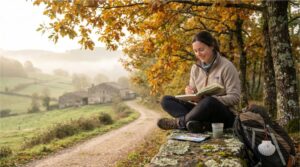
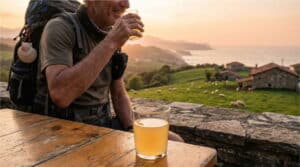
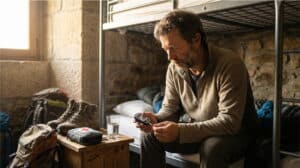
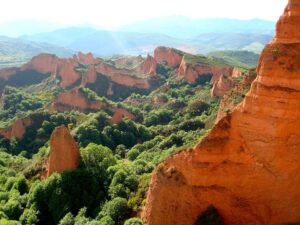
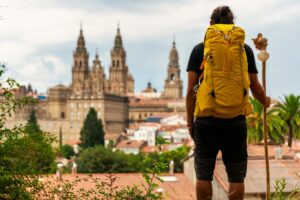
Some journeys are remembered through photographs, while others linger in memory for what they “stir” inside us. For many, the Camino belongs to this second category: a route that organises thoughts, sparks conversations, and transforms the everyday acts of walking, eating, and resting into a ritual with its own rhythm. It is no surprise, then, that over the centuries it has inspired music, stories, diaries, drawings, photographs, and poetry.
In this article, we explore why pilgrimage encourages creativity. We will discuss which traditions and symbols act as artistic triggers, which times of year facilitate a “Creative Camino”, and which routes (and stages) generally offer the best conditions for writing, creating, or simply observing with greater attention.
Índice de contenidos
- 1 Why walking sparks ideas
- 2 The Camino as a living “cultural archive”
- 3 Works, stories, and contemporary perspectives
- 4 Routes and sections with higher creative potential
- 4.1 Camino del Norte: dialogue with the sea
- 4.2 Camino Francés: heritage, villages, and narrative “scenes”
- 4.3 Camino Primitivo: historic origin and mountain-inspired creativity
- 4.4 Portuguese Way: tradition, historic roads, and a more “human” creativity
- 4.5 English Way: compact format, Atlantic light, and ideal route for creative series
- 4.6 Sections with powerful rituals: when symbol becomes art
- 4.7 How to choose “your” creative route
- 5 Traditions and symbols that spark imagination
- 6 When to do a “Creative Way”: seasons, weather, and tranquility
- 7 Simple practices for creating without “forcing it”
- 8 Creative ethics: creating without invading
- 9 How to turn your experience into a finished work
- 10 The Way as a workshop on the move
Why walking sparks ideas
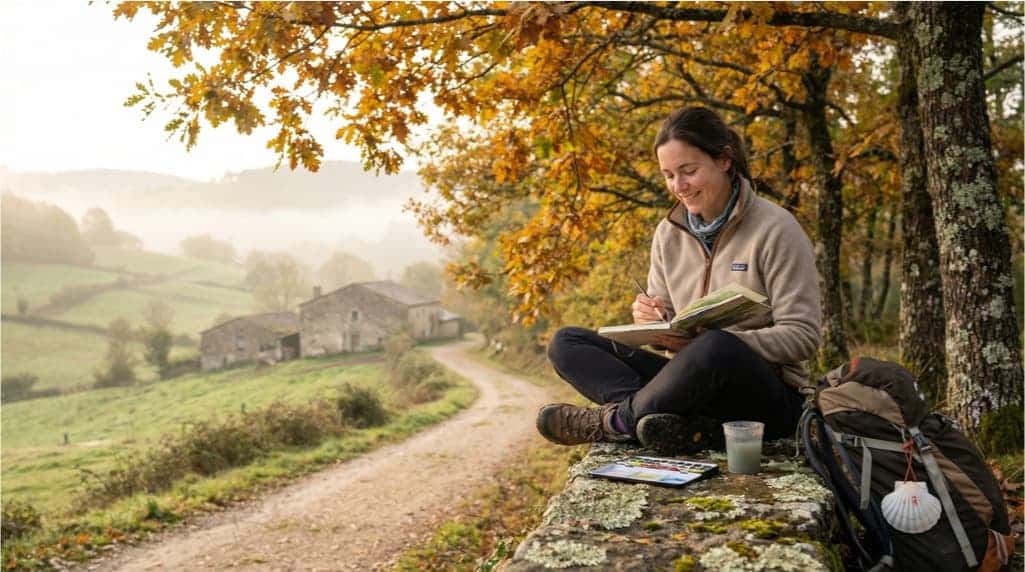
Creativity does not only appear when “we sit down to think”; it emerges when the body and environment help the mind shift gears. Walking directly stimulates that change. Psychological research has shown that walking can improve idea generation (especially in divergent thinking tasks, like producing alternatives or associations), and the effect is noticeable both during and shortly after walking.
Moreover, when walking takes place in natural settings —forests, rural paths, coastlines, hills— additional factors come into play: fewer interruptions, relative silence, reduced screen exposure, and the type of “soft” attention inspired by landscapes (watching the sky, listening to water, following a trail).
Together, these elements foster a mind more open to connecting memories, organising emotions, and generating new ideas.
The Camino naturally combines several ingredients often associated with creative moments:
- Repetitive rhythm (steps, breathing, stages) that calms “mental noise”.
- Transitional space: stepping out of routine creates a sense of “life pause” that encourages reflection.
- Contact with nature and heritage, providing stimuli without overwhelming.
- Shared stories: conversations, coffees, parallel paths, and brief farewells.
- Unhurried time to observe, note down ideas, and rekindle curiosity.
Simply put: when the body moves and the environment supports, the mind finds room to imagine.
The Camino as a living “cultural archive”
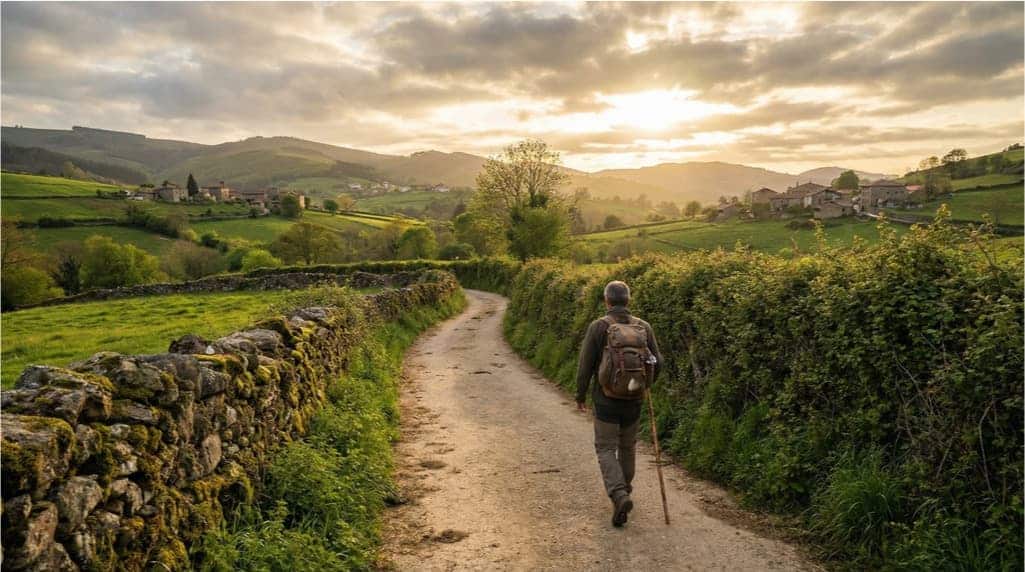
Beyond personal experience, the route is a vast cultural exchange corridor. For centuries, it connected territories, languages, artistic styles, and storytelling methods. Today, this cultural dimension remains visible in churches, bridges, historic hospitals, route markers, traditional songs, and local legends. It is not merely an itinerary; it is a network that has left its mark on European history.
This significance is recognised by international institutions. The Camino has been certified as a European Cultural Route and is described as a symbol of revitalising historic paths of encounter. Additionally, some sections have World Heritage recognition, partly for their role in cultural exchange and the tangible heritage associated with pilgrimage.
It is also worth noting that the experience has long been documented. A key example is the Codex Calixtinus (12th century), a manuscript linked to the Jacobean tradition containing, among other things, liturgical texts and materials interpreted as a medieval guide for pilgrims. Its mere existence demonstrates that the route has long inspired storytelling, music, descriptions, and cultural memory.
Works, stories, and contemporary perspectives
In more recent times, pilgrimage has featured in books, films, and diverse creative projects. Two references help illustrate its impact:
- The Pilgrimage (Paulo Coelho): a novel based on the author’s journey along a specific route, blending physical travel with inner exploration.
- The Way (Emilio Estévez, 2010): a film that gained international popularity and has inspired many to take up the walk themselves.
You do not need to like these works for them to be useful: they serve as mirrors. They show how the route lends itself to storytelling, featuring a clear beginning (departure), a development through stages (challenges, fatigue, encounters, transformations), and a symbolically charged ending (arrival in Santiago, sometimes extended to the coast).
Routes and sections with higher creative potential
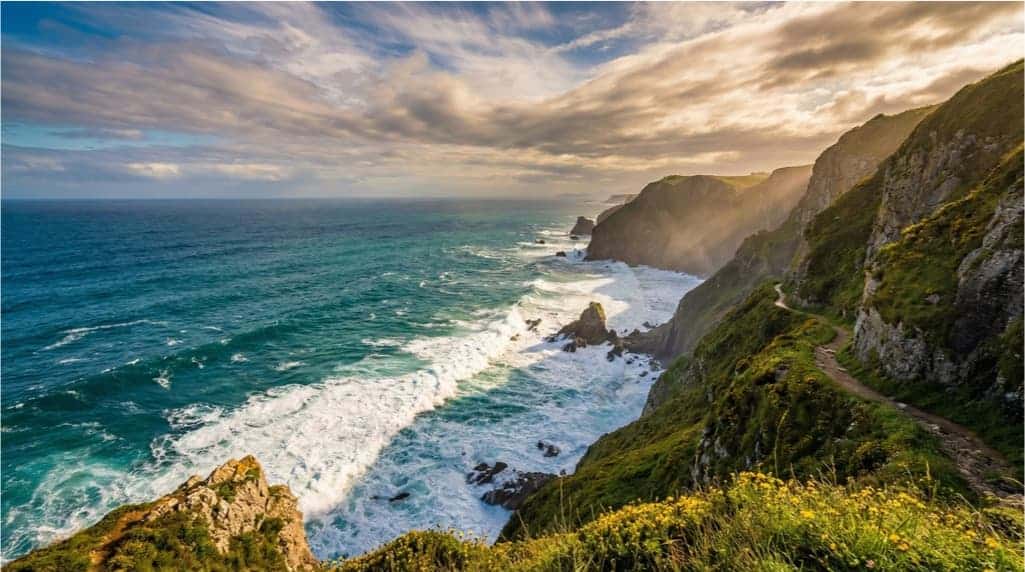
Creativity does not depend solely on location, but the setting can foster it. On the Camino, factors such as pilgrim density, landscape type, availability of quiet spaces, proximity to sea or mountains, climate, and the “tempo” of each stage (whether it forces you to rush or allows time to stop, look, and write) influence creative output.
Below is a practical guide —without dogma— on the creative potential of certain routes and stages. Use it as a map of sensations: you decide what inspires you most.
Camino del Norte: dialogue with the sea
If your creativity thrives on wide horizons, changing light, and constant sounds (waves, wind), the Norte is a strong ally. The coast provides a natural narrative: cliffs, beaches, fishing villages, and a variable climate that changes the mood of the day. This “constant change” works particularly well for visual artists and writers who work with atmospheres.
A particularly inspiring section for those seeking sea and writing stage by stage is the Camino del Norte from Gijón to Ribadeo. Along its stages, the Atlantic character and pace can suit a diary, photography, or quick sketches.
- Ideal for: travel journals, landscape photography, contemplative writing, sound projects (field notes), quick watercolours, route collages.
Camino Francés: heritage, villages, and narrative “scenes”
The Francés offers a clear advantage for creators: a high concentration of heritage, towns with distinct identity, and a highly structured stage system, perfect for chapter-based projects. If you are writing a serial novel, a journal with fixed structure, or a series of illustrations (one per day), this route works very well.
For those seeking an urban cultural start with historic atmosphere, the Camino Francés from Burgos may be appealing. The town and its surroundings offer contrast between monumental city and open-stage countryside, providing rich narrative opportunities.
If, instead, you want a section combining landscape, culture, and a pace that allows writing without feeling “behind schedule”, the Camino Francés from Logroño is very suitable. Walking through transitional zones between towns and rural areas is fertile ground for ideas, especially if your work involves descriptions, character observation, or short scenes.
- Ideal for: reportage, travel novels, stage-based illustration, architecture and detail notes, projects on gastronomy and local culture.
Camino Primitivo: historic origin and mountain-inspired creativity
For a more introspective creative experience —less “social scene” and more inner observation— the Camino Primitivo is a good fit. Not only because of its more demanding profile in certain sections, but also due to its symbolic weight: it is considered the oldest route, linked to the first documented royal pilgrimage, connecting Oviedo with Santiago through landscapes where nature dictates the pace.
Creatively, it is a route that invites you to work with silence, pause, and background writing: reflective notes, more intimate diaries, photography of mist, forest textures, and stories where the “mood” (both emotional and environmental) becomes a character.
- Ideal for: personal diary, poetry, atmospheric photography, sketchbook with landscape and natural detail, “logbook” projects (text + drawing).
- Creative tip: on routes with more mountainous profiles, energy takes the lead. If you want to create, it works better to set a small daily goal (for example, 10 lines at night or 1 themed photo per day) and leave the “major work” for your return.
Portuguese Way: tradition, historic roads, and a more “human” creativity
The Portuguese Way stands out for its unique identity and historical relevance since the Middle Ages. Its path follows ancient roads (with references to Roman roads in some sections) and generally offers a balanced mix of lively towns, heritage, and stages that usually allow for stopping to observe without disrupting the rhythm.
Creatively, it is a very fertile route for stories of encounters: conversations, everyday village scenes, notes on gastronomy, and small stories born from pilgrim interactions. If your project is based on characters, dialogue, reportage, or narrative “postcards,” there is usually abundant material here.
- Ideal for: travel writing, social portrait (written or photographic), gastronomic and cultural projects, diaries focused on conversations and scenes.
- Creative idea: “collection of voices of the Way.” Each day, write down a phrase you’ve heard (without personal details) and turn it into a micro-story or a 4-line poem.
English Way: compact format, Atlantic light, and ideal route for creative series
The English Way is especially interesting if you want to undertake a creative project with a very defined beginning and end in just a few days.
Creatively, it works very well for series work: one photo per stage with a fixed theme, a notebook with 5–7 entries, or a collection of small illustrations in a consistent format. It is also a forgiving route for those who want to combine urban moments (at the start) with inland sections where silence appears more easily.
- Ideal for: photographic series, mini illustrated notebooks, linked short stories, “few-day” projects with a clear ending.
Sections with powerful rituals: when symbol becomes art
Some places on the Way carry deep meaning due to traditions repeated over years. They are not “mandatory,” but can be useful if you are interested in working with symbolism. The clearest example is the Cruz de Ferro on the French Way, where many pilgrims leave a stone as a symbolic gesture of letting go or closing an inner stage.
If your creative project is based on metaphors (grief, change, farewell, transformation), these types of rituals provide intense and often respectful scenes. A brief text or a well-composed photograph can convey a lot without needing excessive explanation.
How to choose “your” creative route
Instead of asking “Which route inspires the most?”, it is better to ask yourself:
- Do I need silence, or does the social environment inspire me?
- Do the sea, the mountains, or urban heritage energise me more?
- Do I want to create every day (micro-works) or prefer to gather material and produce at the end?
- Does a route with “scenes” (villages, squares, cafés) help me, or one with “emptiness” (horizons, repetition)?
Answering these questions is more useful than any ranking.
Traditions and symbols that spark imagination
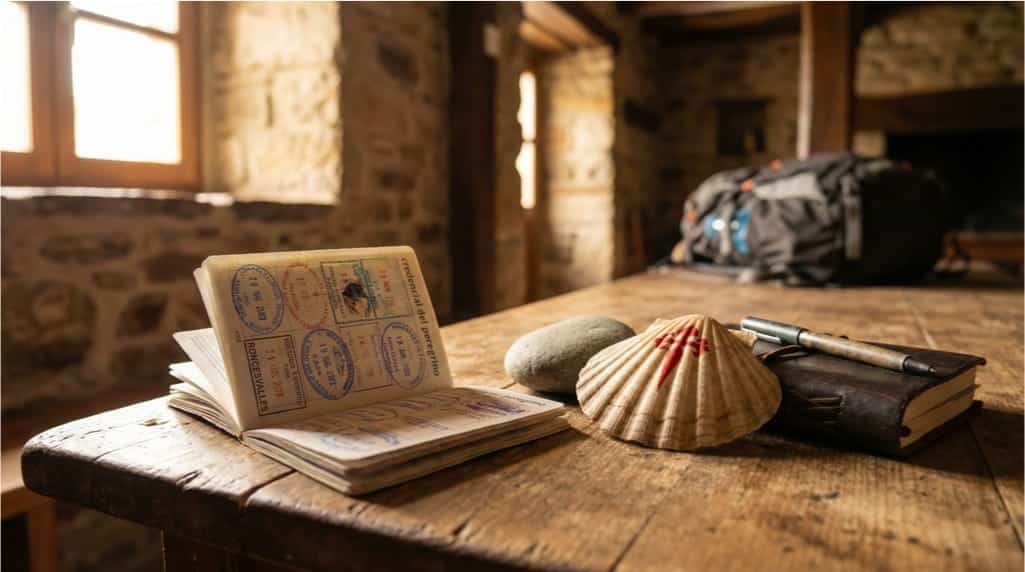
The Way is not just about walking: it is a culture of signs. And signs feed creativity because they condense stories into small objects. Here are some of the most common:
The Credential and Compostela: storytelling with stamps
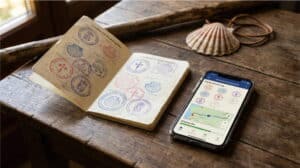
The credential works as a document of passage and memory. Each stamp is a scene: a hostel, a parish, a bar, an encounter. For many people, the stamped page becomes a emotional map of the journey.
- Creative idea: turn the stamps into “chapters.” Write one line per stamp, or draw a symbol for each day. The result can become a complete notebook-work without planning to.
The shell: a minimal icon with many meanings
The scallop shell is another of the pilgrim’s most recognisable symbols. It appears on milestones, signage, and personal objects. Historically, it has been interpreted as a pilgrimage marker, and also had practical traditional uses. For a creator, the shell serves as a perfect visual resource: simple, repeatable, with endless variations (texture, light, context).
- Creative idea: a “shell study” in 10 versions: macro photo, line drawing, watercolor, short poem, collage with tickets, 100-word story, etc.
The Botafumeiro: total scene (smell, sound, sight)
The cathedral offers moments with sensory power that are difficult to replicate. Among them, the Botafumeiro stands out as a liturgical and symbolic experience: it is not a guaranteed daily spectacle, but a ritual linked to specific solemnities and celebrations. Precisely for that reason, when it occurs, it concentrates emotion, memory, and a very particular aesthetic (smoke, height, movement, collective silence).
- Creative idea: describe the Botafumeiro without using the word “incense.” This forces the use of metaphors and refined language.
Holy Year and Holy Door: extraordinary time
During Santiago’s Holy Years, the opening of the Holy Door and the jubilee framework turn the pilgrimage into a “special” time for many people. You don’t need to experience it religiously to feel its cultural impact: it changes the atmosphere, the symbolism of arrival, and how the end of the Way is perceived.
- Creative idea: work with the contrast between “ordinary and extraordinary time”: what changes when we feel that a year or a moment “matters more”?
Finisterre and closing rituals: responsibly
For some pilgrims, the end is not in Santiago but on the coast (Fisterra/Muxía). Closing rituals, such as leaving objects or burning clothes, have become popular. It is important to stress that burning garments is not allowed and is discouraged for environmental and safety reasons.
Even so, the desire to “close a cycle” is real and can be transformed into a harmless creative gesture: write a letter and keep it, leave a stone in an approved spot, or take a final photo without leaving a trace.
When to do a “Creative Way”: seasons, weather, and tranquility
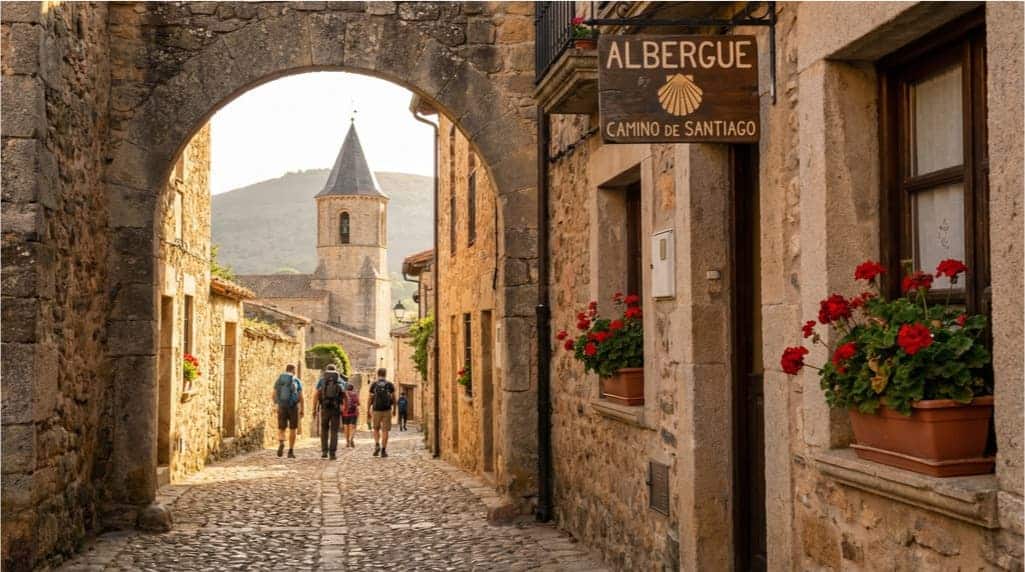
There is no universal perfect date. But there are useful patterns: the experience changes significantly between peak season and quieter months. Recent attendance statistics show peaks in late spring and summer (and also in September), which usually translates into more social atmosphere… and less silence.
As a practical rule:
- If you seek conversation and stories (human material), the months with more pilgrims may be interesting.
- If you seek calm and focus (long writing, detailed drawing), it is usually best to avoid peak months and choose intermediate seasons, accepting more variable weather.
| Season | Favours | For what type of project |
| Spring (April–June) | Soft light, lively landscape, comfortable pace | Diary, photography, watercolor, reportage |
| Summer (July–August) | High social activity, long stages with daylight hours | Stories of encounters, social portrait, interviews |
| Autumn (September–October) | Good light, melancholic atmosphere, cooler temperatures | Poetry, short stories, detailed photography, intimate diary |
| Winter | Solitude and reflection (but demanding weather) | Introspective and minimalist writing (for experienced planners) |
- Creative tip: if your priority is the work rather than “accumulating kilometres,” plan stages with margin: arrive early, pause mid-stage, or schedule a rest day every few stages to organise notes and sketches.
Simple practices for creating without “forcing it”
Creativity on the road works best when supported by small habits. Here is a realistic practice kit:
For writers
- 10-line micro-diary: every night, maximum 10 lines. No corrections.
- Detail list: note 5 concrete things per day (a smell, a phrase heard, a texture, a colour, a gesture).
- One scene per stage: write a brief scene with a beginning and end, even if minimal (a coffee, rain, conversation).
- Walking writing: record voice notes while walking; then transcribe the essentials.
For illustrators and visual artists
- Limited series: decide on a fixed format (e.g., 1 A6 drawing per day). Restrictions help.
- Shadow study: the Way constantly changes light; try drawing only shadows and outlines.
- Emotional map: instead of mapping kilometres, map sensations with colours or symbols.
For photographers
- Single theme: hands, backpacks, signs, doors, feet, water… A theme gives coherence and avoids “shooting aimlessly.”
- Triptychs: each day, 3 photos that tell a story (beginning–middle–end).
- Respect: ask permission for close portraits and sensitive spaces (hostels, emotional moments).
For musicians and sound creators
- Field notes: water, wind, bells, footsteps, sticks.
- Marching rhythm: your own pace can become a pattern.
- Voices: collect phrases (with consent) and create a “Way archive.”
Creative ethics: creating without invading
The Way is an intimate space for many people. If you are going to create, it is advisable to follow three simple rules:
- Consent: if someone is recognisable and the material will be published, ask permission.
- Do not romanticise others’ pain: the Way stirs emotions; respect them.
- Leave no trace: avoid actions that harm the environment or generate “symbolic” waste.
How to turn your experience into a finished work
Many projects are lost upon returning home because the material is scattered. A simple method to close the process:
- Download: within 48 hours, organise the essentials (notes, audio, favourite photos).
- Choose a format: edited diary, series of 12 photos, illustrated notebook, long story, short poetry collection.
- Define a thread: a theme (sea, encounters, silence, faith, fatigue) or a question (“what changed?”).
- Publish small: share a short piece first. It will give you energy to finish the larger work.
The Way as a workshop on the move
Creativity does not always arrive as a “brilliant moment.” Sometimes it comes as a sum of steps: repetition, landscape, conversation, fatigue, and calm. The Way, by design, provides that framework: a simple life over a few days that, without promising anything, often offers clarity.
If you are thinking of experiencing the route with a creative focus — whether writing, drawing, photographing, or simply observing — you can start by planning your pace, choosing the season that best fits your idea, and giving yourself permission to pause.
And if you want to complete the experience with logistical support to focus on walking (and creating), you can explore experiences on the Camino de Santiago and choose the route format that best suits your project.