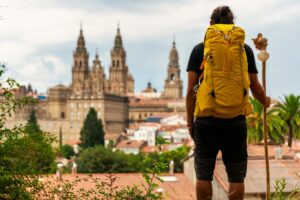
For centuries, millions of pilgrims from all over the world have travelled the routes leading to the tomb of the Apostle Saint James in Compostela. They embark on this journey seeking spiritual guidance, the strengthening of their faith, and a deep connection with Spain’s history and culture. Today, the Camino is more alive than ever: in 2024, almost half a million people completed one of its routes, reaching a historic record in the number of pilgrims.
Along the Camino, various Jacobean symbols have emerged that are easily recognisable. The yellow arrow marking the way, the scallop shell identifying the pilgrim, the gourd for carrying water, and the wooden staff… and, of course, the emblematic Cross of Saint James. This bright red cross, half Christian cross and half sword, is one of the oldest and most meaningful emblems associated with the Jacobean pilgrimage.
Although nowadays the Camino is more accessible than ever — there are companies that organise the Camino de Santiago offering assistance with luggage logistics, accommodation, and other services — the spiritual essence of the route remains intact.
Índice de contenidos
Historical origin of the Cross of Saint James
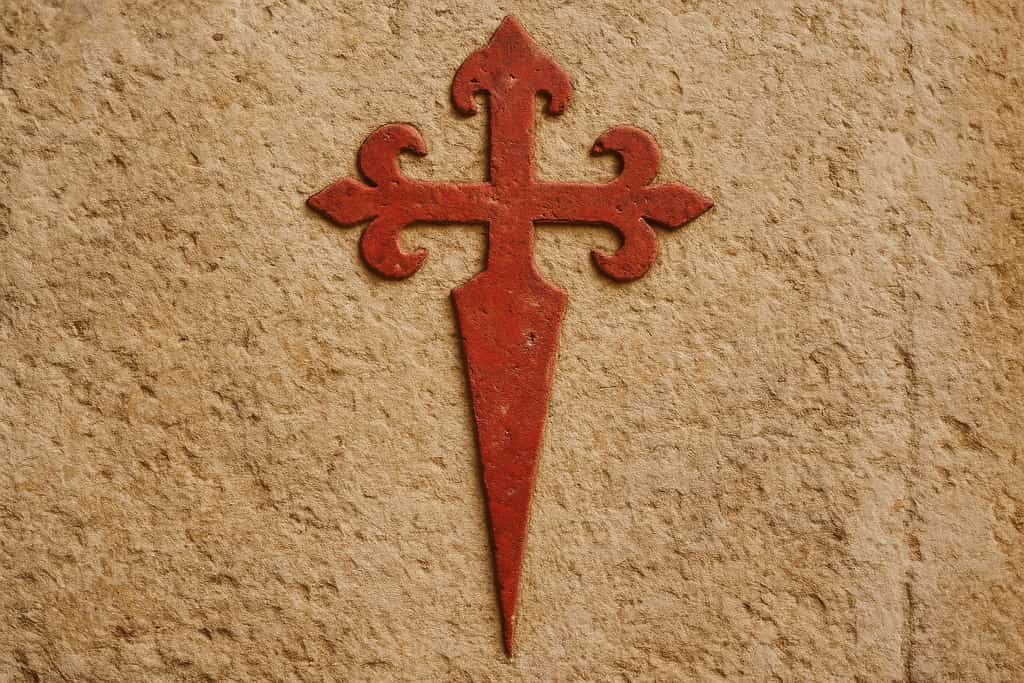
The Cross of Saint James is the distinctive symbol of the ancient Order of the Knights of Saint James, a religious and military order founded in the 12th century.
This order took its name from the Apostle James the Greater, patron saint of Spain. Its main mission was to protect the pilgrims who walked the Camino, providing them with shelter, food, and spiritual aid. In the context of the Crusades and the Reconquista, they also fought to defend the Christian kingdoms of the north and to drive Muslim forces out of the Iberian Peninsula.
Pope Alexander III approved the rule of the Order in 1175, including the adoption of a red cross as the official insignia of its members. From then on, the knights wore this emblem on the chest of their white cloaks, shaped like a sword in honour of their vow to the Apostle and as a symbol of their readiness to defend the faith.
The Battle of Clavijo
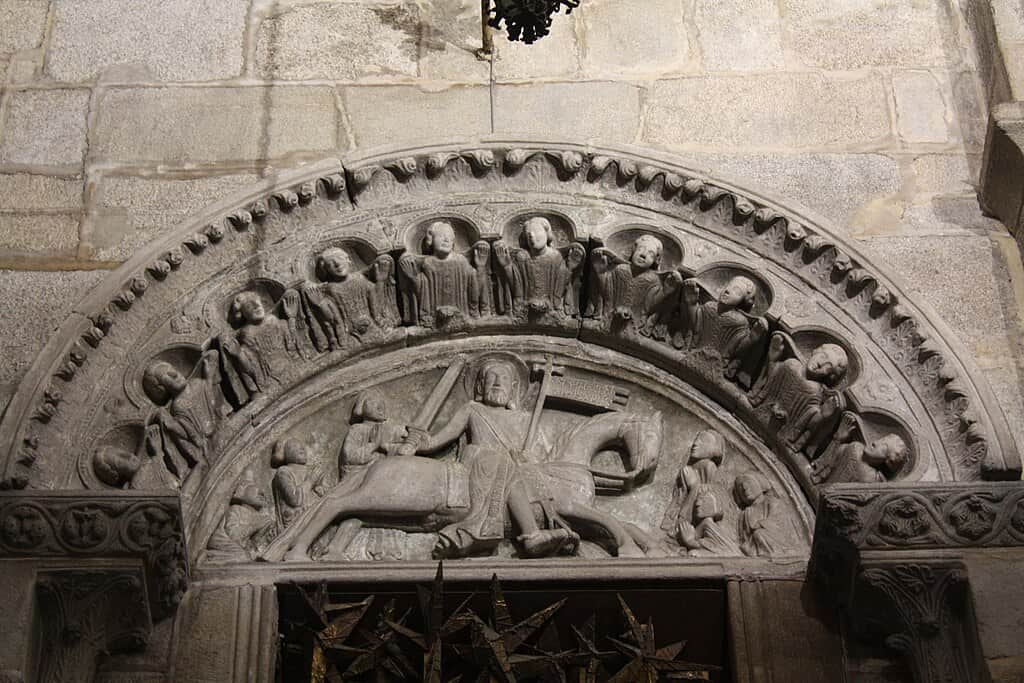
But where does this peculiar red cross shaped like a sword come from? Tradition places its origin in a legendary episode predating the foundation of the Order.
According to legend, during the famous Battle of Clavijo in the year 844 – fought between Christians and Muslims in the lands of La Rioja – the Apostle Saint James miraculously appeared in the middle of the battlefield. Mounted on a white horse and bearing a banner with a red cross, he was said to have intervened in favour of the Christian troops, tipping the victory to their side.
From that story onwards, Saint James the Moor-slayer became a symbol of divine protection in battle, and the red cross on his banner became forever associated with the Apostle.
Crusades in the Holy Land
Another theory about its origin takes us back to the era of the Crusades in the Holy Land. It is said that medieval Christian knights carried small crosses with pointed lower ends so that they could plant them in the ground when camping or praying.
These portable sword-shaped crosses served to mark their presence and devotion, using the cross symbolically as a sacred “stake” in the land of pilgrimage. This piercing design may well have inspired the characteristic shape of the Cross of Saint James as we know it today.
Whatever the true version of its origin may be, the fact is that since the 12th century the red Jacobean cross has been inseparably linked to the Order of Saint James and to the Camino itself. The Cross of Saint James came to represent both the divine protection of the Apostle over pilgrims and the military vocation of the knights who safeguarded them. In short, a symbol of faith and struggle tied to Jacobean history.
Meaning of the Cross of Saint James
Also known as the “sword cross” because of its shape, it is in fact a Latin cross whose appearance clearly resembles a sword. It features a straight, pointed shaft similar to a blade, and a short hilt. The side arms and upper end of the cross are finished with fleur-de-lis motifs, giving it a stylised and elegant appearance.
In traditional heraldry, the fleur-de-lis – with its three petals – symbolised “spotless honour” and purity. Indeed, the three fleur-de-lis found in the Cross are thought to represent the moral virtues attributed to the Apostle Saint James (such as faith, integrity, and courage), while also referring to the Holy Trinity.
Its distinctive red colour also carries powerful symbolism. Red evokes the blood shed by the Apostle Saint James during his martyrdom in Jerusalem, when he was beheaded for defending his Christian faith in the 1st century. (He is said to have been the first martyred apostle, executed by the sword around 44 AD.) At the same time, the colour represents the blood shed by the Christian knights and soldiers who gave their lives in defence of the faith throughout history.
The unique form of the cross and sword therefore embodies a double meaning.
- On the one hand, it is a religious symbol alluding to the cross of Christ and the sacrifice made for faith.
- On the other, with its sword-like shape, it conveys the idea of active defence of Christianity, as though faith itself were “militarised”.
The Cross of Saint James in culture and tradition
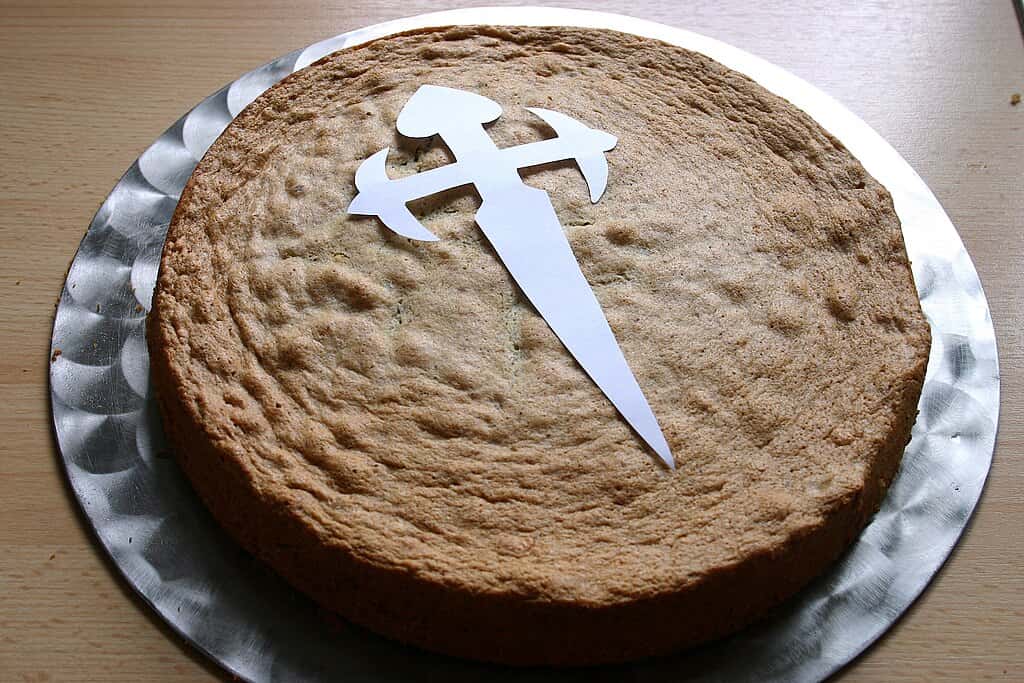
The historical importance of the Cross of Saint James has been reflected in countless artistic, cultural, and popular expressions over the centuries. Here are some notable examples of its presence:
- Coat of arms of the city: The official coat of arms of the Galician capital includes the red Cross of Saint James, usually placed behind the depiction of the Apostle’s tomb (in marble or silver) within the city’s heraldic design.
- Tarta de Santiago: The famous traditional Galician almond cake is decorated by dusting icing sugar over a stencil with the silhouette of this symbol, leaving its mark in the centre. This technique has become the cake’s unmistakable hallmark.
- Las Meninas by Velázquez: In the celebrated painting Las Meninas (1656), exhibited at the Prado Museum, Diego Velázquez portrayed himself wearing the Cross on his chest. It is believed that this detail was added a few years after completing the work, when he was named a knight of the Order of Saint James and granted the right to bear the cross on his attire.
- Modern symbols: The crest of the Real Club Celta de Vigo football team has featured a large Cross of this kind as the central element of its design since 1928, highlighting the Jacobean and Galician identity of the club. Likewise, many coats of arms of institutions, municipalities, and even noble families across Spain have incorporated it over the centuries to signify their connection with the values it represents.
The Cross of Saint James today
In our time, beyond its echoes in history and art, it has become a living symbol within the modern-day experience of the Camino de Santiago.
Many pilgrims identify it as the emblem of their spiritual journey. It is common to find it on waymarkers and Camino signs, on façades, or adorning the scallop shell itself alongside the yellow arrow. In fact, many walkers choose to tattoo the Jacobean cross upon completing their pilgrimage as an indelible reminder of their experience.
The Cross of Saint James unites pilgrims from all Jacobean routes under a single symbol. It matters not whether the traveller follows the busy French Way, chooses the Camino de Santiago Oporto Tui along the Portuguese Way, takes the Spiritual Variant to Santiago, or even begins in Galicia via the >Camino de Santiago from Ourense. On any of these routes, this symbol will be present: in chapels, monasteries, signposts, and even in the souvenirs and crafts that line the way, serving as a symbolic link among all paths.
Ultimately, the Cross of Saint James endures as a timeless icon and a universal emblem of the Camino. This symbol, forged between faith and history, continues to inspire modern pilgrims and remind them of the profound significance of the journey they undertake.
Understanding its origin and meaning adds an extra layer of depth to the pilgrimage: every time a walker sees the red cross along their way, they feel united with centuries of devotion, courage, and hospitality — realising that they are part of a millennia-old tradition.