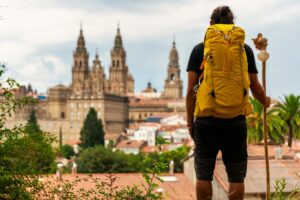
The French Way of the Camino de Santiago is the most popular and frequently travelled pilgrimage route. One of the first questions future pilgrims have is how many days are needed to complete it. Generally, walking it from Saint Jean Pied de Port takes around a month.
In this article, we will detail the typical stages of this route, options to adapt it to your available time, and compare its duration with other Camino de Santiago routes. We will also share advice on how to plan each day and the sense of companionship that comes with this experience.
Índice de contenidos
Total Duration of the French Way (from start to finish)

As mentioned, it begins at Saint Jean Pied de Port in southern France and ends at the Santiago de Compostela Cathedral after roughly 780 km.
How many days does this journey take? For an average pilgrim, completing the entire French Way takes 4 to 5 weeks. Traditional guides divide this route into around 30 to 35 daily stages, with an average of 20 to 25 km walked per day.
On average, from this starting point, it usually takes about 31 days to reach Santiago. If you start in Roncesvalles (Navarra), the first point in Spain, the estimated time is 30 days, as it avoids the initial stage crossing the Pyrenees.
It’s important to note that these figures are averages. Actual duration depends on each pilgrim’s pace, whether rest days are taken, and physical condition. Many walkers complete standard stages of ~25 km in about 6 hours of walking, allowing time to rest and explore towns at the end of each day.
However, there is no mandatory number of days: some walk shorter stretches and take more days, while fitter adventurers may speed up or even cover two stages in one day (though this is not common). Ultimately, the duration is decided by you according to your abilities and preferences.
Stages of the French Way: sections and number of days
Dividing the French Way into blocks is a very convenient way to tackle it if you don’t have 30 consecutive days or if you want to “try it out” in parts. Each section coincides with a change in landscape and difficulty, and all have a good network of accommodation. Broadly speaking, we can talk about 5–6 clear sections:
- Saint Jean Pied de Port – Roncesvalles: 1 stage (≈25 km).
- Roncesvalles – Logroño: 6 stages.
- Logroño – Burgos: 5 stages.
- Burgos – León: 9 stages.
- León – O Cebreiro: 6 stages.
- O Cebreiro – Santiago de Compostela: 7 stages.
Together, these sections make up the 34 typical days of the French Way.
Section Saint Jean Pied de Port – Roncesvalles (1 stage)
- Estimated duration: 1 day of walking.
- Distance: ~25 km.
- Description: this is the iconic starting stage, very scenic but also one of the toughest of the Camino due to the accumulated elevation. There is a steady climb through the Pyrenees to the high area (col de Lepoeder, depending on the variant) and then a descent towards Roncesvalles.
It’s advisable to travel light, watch the time, and not underestimate it. Many pilgrims arrive the day before in Saint Jean to start early. Those who want to make it easier can take the Valcarlos variant or even split it by staying in intermediate hostels on the French side.
Section Roncesvalles – Logroño (6 stages)
- Estimated duration: ~6 days of walking.
- Distance: ~130 km.
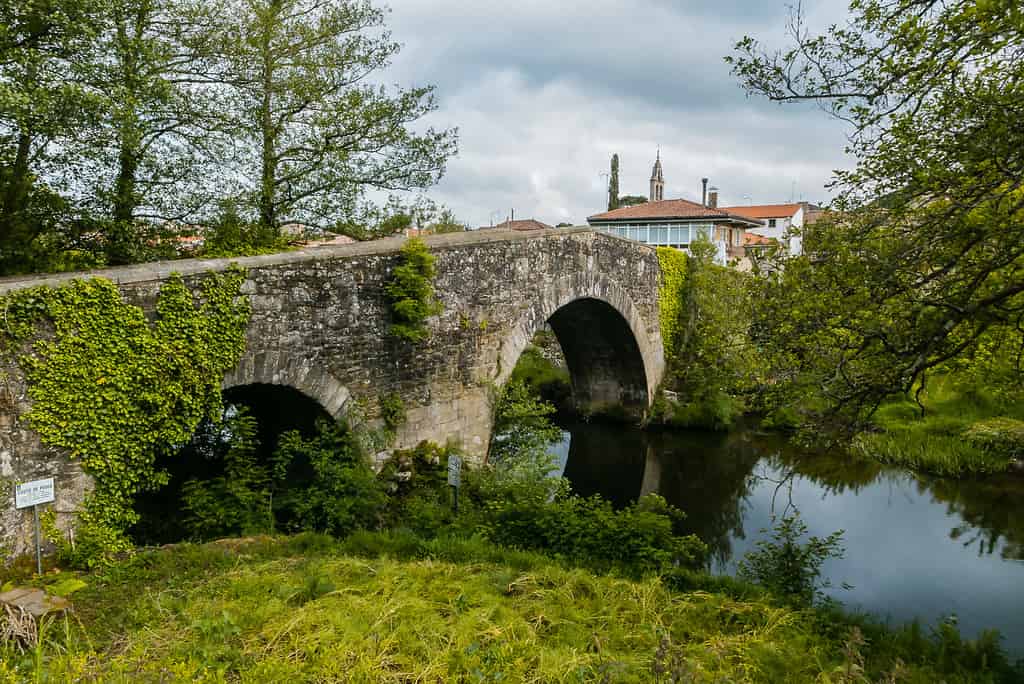
- Description: the Camino de Santiago from Roncesvalles to Logroño is very rewarding: Navarrese forests at the start, passing through Pamplona, and later historic bridges and towns such as Puente la Reina or Estella. These are standard stages of 20–25 km, with plenty of bars, fountains, and accommodation options, making it easy to adjust distances.
It’s an ideal section for socialising as many people start in Roncesvalles. By the end of this section, you enter La Rioja, and the change in landscape is noticeable. Those with lower fitness can split the first long stage (Roncesvalles–Zubiri) or the Puente la Reina–Estella stage.
Section Logroño – Burgos (5 stages)
- Estimated duration: ~5 days of walking.
- Distance: ~120 km.
- Description: the Camino de Santiago from Logroño to Burgos starts near the La Grajera reservoir and crosses towns with a rich Jacobean heritage such as Nájera and Santo Domingo de la Calzada in a few days. This is a transitional section: leaving the vineyards behind and entering the Castilian plain before Burgos. The stages are well measured, so stronger walkers can combine two shorter ones.
Burgos is a good place for a one-day pause: it has all services, a train station, and a UNESCO World Heritage Cathedral.
Section Burgos – León (9 stages)
- Estimated duration: ~9 days of walking.
- Distance: ~180 km.
- Description: the Meseta section: on the Camino de Santiago from Burgos to León you will find wide paths, little elevation change, and villages separated by several kilometres. It’s not technically difficult, but it can be monotonous, and here the wind, heat, or cold dominate.
The advantage is that there are many intermediate towns (Castrojeriz, Frómista, Carrión, Sahagún…) to shorten or extend stages. Some pilgrims “gain a day” by combining 18–20 km stages. Others go slower to avoid overexerting their legs.
Section León – O Cebreiro (6 stages)
- Estimated duration: ~6 days of walking.
- Distance: ~150 km.
- Description: after the stop in León, the Camino becomes lively again: Hospital de Órbigo, Astorga, and the ascent into Maragatería introduce more variety. Then comes El Bierzo (Ponferrada, Villafranca), a very pleasant valley to walk through.
The main challenge on the Camino from León to O Cebreiro is at the end: the climb to O Cebreiro, the gateway to Galicia. That day it’s advisable to measure your strength carefully or even split it by staying overnight in Herrerías or La Faba. It’s a section with plenty of services and a beautiful mix of cities, historic towns, and mountains.
Section O Cebreiro – Santiago de Compostela (7 stages)
- Estimated Duration: ~7 days of walking.
- Distance: ~155 km.
- Description: Galicia welcomes pilgrims with gentle ups and downs, closely spaced villages, and plenty of services. You pass through Triacastela, Sarria (where many people join who only walk the last 100 km), Portomarín, Palas de Rei, and Arzúa. This means more atmosphere and more accommodation options, but also more crowds during peak season.
The advantage of the Camino from O Cebreiro to Santiago is that you can adjust the stages very well: make them shorter if you’re tired or combine Arzúa–Santiago into a single long day. It’s the most exciting section because each day you can feel the destination getting closer.
As you can see, walking all the stages means about 33 effective walking days if starting from Roncesvalles (around 34 if starting in Saint Jean). You might also add a day of rest in some cities (for example, some people take a day off in Burgos or León for sightseeing and recovery). In any case, more than a month is usually a sensible amount of time to set aside if your plan is to walk the full Camino Francés at a relaxed pace.
Many people choose to split it into several sections and walk them at different times if they don’t have 30 consecutive days. For instance, you could complete it in annual stages: one year from Roncesvalles to Logroño, the next from Logroño to Burgos, and so on until reaching Santiago.
Of course, it is also possible to join the Camino at intermediate points depending on the time available. For example, starting in Sarria (~115 km from Santiago) takes about 5 days. Starting from León is around 14–15 days; from O Cebreiro, ~7 days, etc. Each pilgrim chooses the section according to the days they have, knowing that any starting point is valid as long as you walk at least the last 100 km to receive the Compostela.
Duration of the Camino Francés vs other Camino de Santiago routes
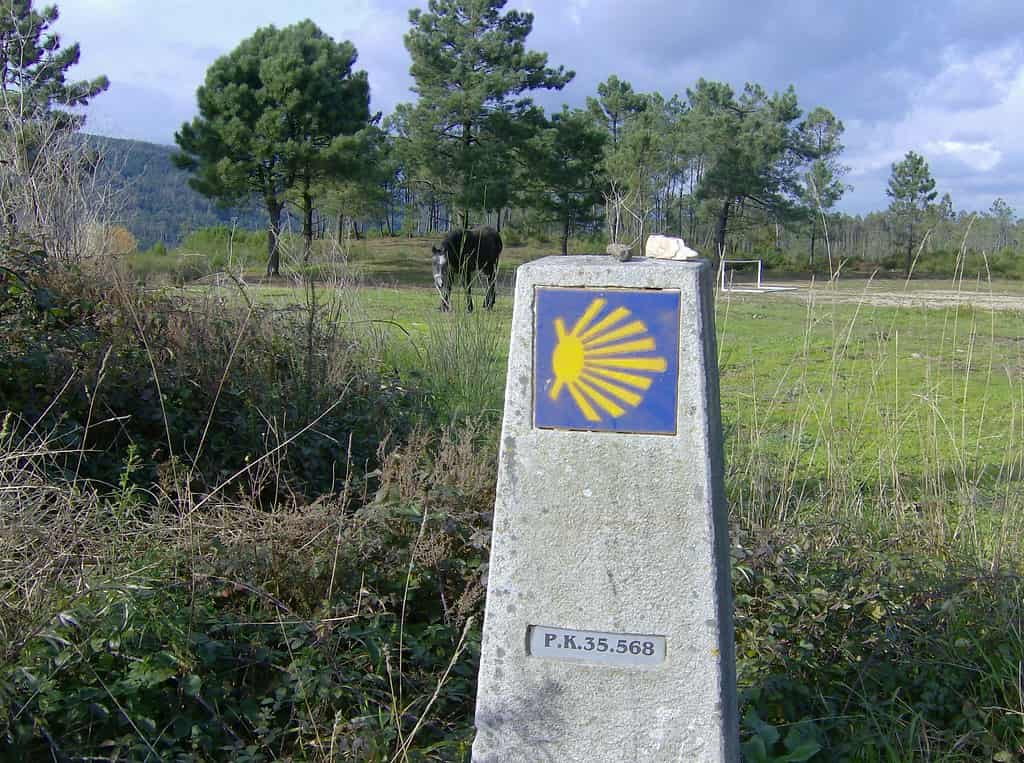
This is not the only Camino route. There are several, each with its own characteristic distance and duration. Below is a brief comparison of the Camino Francés with other main routes for an overview:
- Camino Francés: ~781 km in 30–35 stages. It’s the longest route in distance along with the Camino del Norte, and the most popular of all.
- Camino del Norte: ~820 km along Spain’s northern coast, typically divided into 34–35 stages (about 35 days walking). It’s a route of great scenic beauty but more challenging due to continuous ups and downs.
- Camino Primitivo: ~313 km from Oviedo to Santiago. Usually done in about 13 stages (12–15 days depending on pace). It’s a mountainous and solitary route, considered the oldest.
- Camino Portugués: ~615 km from Lisbon (around 26 days on foot). Nowadays, most pilgrims start in Porto (235 km to Santiago), taking around 11–12 days to complete it. Those with less time can start in Tui (115 km away) and finish in 5–6 days. Many split this route into two trips: first doing the various Porto to Tui stages and later Tui to Santiago (~5 days).
-
- There is also the spiritual variant crossing of the Camino Portugués, an optional detour that includes a boat journey: it’s done in 3 walking stages plus a boat segment along the Ría de Arousa.
- Camino Inglés: ~118 km from Ferrol (Galicia), usually done in 5 or 6 stages. There is a variant from A Coruña (73 km) that takes ~3 days, but it does not reach the 100 km required for the Compostela.
As you can see, the Camino Francés is one of the longest in distance and time. Other important routes can be completed in around two weeks or less.
Regardless of the route, there are options for organized Camino de Santiago trips that let you adapt the itinerary to your availability, with accommodation and luggage transport included. This makes it possible to walk any route in the days you have without worrying about logistics.
Tips for planning stages on the Camino Francés
Planning your stages is key to enjoying the experience. Here are tips on how to combine or split stages according to your needs, and recommendations to make your journey as comfortable and rewarding as possible:
Combine stages to reduce walking days
If you have limited days or a good fitness level, you can consider combining stages sometimes. This means walking two sections normally done on separate days in a single long day.
For example, in the final Galician stages, some pilgrims combine Arzúa – O Pedrouzo (19 km) and O Pedrouzo – Santiago (20 km) into a single ~40 km day to reach Santiago faster. Similarly, in the Meseta, some relatively short flat sections can be linked if you feel energetic.
- Precautions: combining stages reduces the total number of days but increases daily effort. It’s not recommended to do this continuously for many days, as fatigue and injury risk increase. The most sensible approach if you want to speed up the Camino is to identify consecutive short stages (e.g., 15–20 km each) and extend the walk on that day to complete the second stage.
Split stages for a more comfortable pace
Conversely, it’s also perfectly valid to split a stage over two days if you think a day will be too long or tough.
For example, Astorga – Ponferrada is usually done in two days, but someone with a slower pace might split it into three, staying an extra night in Foncebadón before descending to Ponferrada. The good thing about the Camino Francés is that almost every stage has intermediate villages where you can stop before the official end if needed.
At Mundiplus, we offer the option to design routes with shorter stages and more days – a choice ideal for older pilgrims or families with children.
If travelling independently, you can plan it yourself: check the guide for intermediate accommodations. For example, the longest stage between Burgos and León is Calzadilla de la Cueza – Sahagún (almost 32 km with hardly any large towns); a walker preferring not to do 30+ km in a day could overnight before Sahagún, shortening that stretch and adding a day to their trip.
- Advantages of splitting stages: walking shorter distances (10–15 km per day) allows you to arrive early, rest more, and explore each place calmly. This gentle pace reduces the risk of injuries and makes the challenge accessible for less fit people. The downside is obvious: more total days are needed to reach Santiago.
Plan with flexibility
Whether planning intense or light days, the key is to maintain some flexibility. You may discover your body tolerates more (or fewer) kilometres than expected and need to adjust on the go.
Factors like weather also matter: extreme heat or heavy rain may suggest shortening a stage, while a cool, cloudy day could encourage extending it. Always carry information about upcoming villages and accommodations along the route, so you can decide to finish a stage earlier or later depending on how you feel.
Also, consider if you want to dedicate extra days to rest or sightseeing. Some cities are worth a pause: Pamplona, Burgos, León, or just enjoying a few hours in Astorga or Ponferrada to explore the heritage. Including one or two “non-walking” days in a 30-day plan can make a big difference for recovery and avoiding fatigue.
In summary, there is no perfect one-size-fits-all plan. Make an estimated stage plan before you depart but be aware you can adjust it as you go. The Camino will guide you, and you’ll always find fellow pilgrims and services to help you adapt.
The experience of good company on the Camino Francés
One of the most valued aspects of the Camino Francés is the camaraderie and companionship among pilgrims. While each person experiences their pilgrimage differently – some seek introspection, others socialising – the fact is you will never be alone. Day after day you share trails and experiences with people from all over the world, creating unforgettable bonds.
Encounters along the way: From day one, greeting others with a “Buen Camino!” establishes a connection. It’s common to start walking alone and, after a few kilometres, strike up spontaneous conversation with a pilgrim keeping your pace. These chats make the hours fly and often start friendships.
On tough stages (e.g., climbing O Cebreiro or crossing the Pyrenees) pilgrims encourage each other, share water or a snack, and wait for each other in difficult sections. Overcoming challenges together builds a strong bond: a natural solidarity where everyone feels a little like a travel companion.