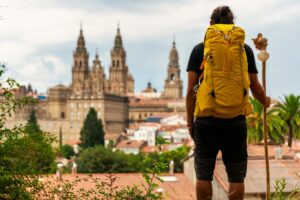
Walking the French Way is not just a spiritual or athletic experience. It is, above all, a journey through centuries of European architectural history. Every church you encounter, every monastery that rises on the horizon, tells stories of faith, ingenuity, and artistic evolution that date back to the Middle Ages.
For over a thousand years, two architectural styles dominated the construction of religious temples on the Iberian Peninsula: Romanesque and Gothic. Both left their indelible mark on the French Way, transforming this route into an open-air gallery where stone becomes art. If you are a pilgrim seeking to understand what lies behind each arch, each vault, and each stained glass window, this guide will reveal the secrets of the most fascinating monuments along the route.
Índice de contenidos
- 1 Romanesque Art on the French Way: Origins and Characteristics
- 2 Essential Romanesque Monuments on the French Way
- 3 The transition to Gothic: changes in the architecture of the route
- 4 Gothic gems on the French Way
- 5 Architectural comparison: other routes of the Camino de Santiago
- 6 How to make the most of your journey to discover these monuments
- 7 The French Way as a medieval art gallery
Romanesque Art on the French Way: Origins and Characteristics
Romanesque arrived on the Iberian Peninsula around the 11th century, brought by pilgrims, monks, and merchants traveling from France. This architectural style emerged as a response to the needs of a medieval society seeking to build larger and more resilient temples than its predecessors.
On the French Way, Romanesque was not an imposition from abroad, but rather a natural evolution. Local master builders adopted French techniques and adapted them to the terrain, climate, and materials available on the Peninsula. The result was a unique version of Romanesque: more robust, more austere in some aspects, but equally captivating.
Architectural Features of Romanesque on this Route
Romanesque is identified by very particular elements that you will find in almost every church from this period.
The semi-circular arches are its most recognisable hallmark: those perfect semi-circles that support the roofs and create an almost unbreakable sense of solidity. Barrel vaults, which look like stone tunnels, distribute the weight of the structure evenly.
But there is more. Thick walls, almost defensive, protected the interior from the elements. The small windows, barely openings in the stone, allowed light to enter dramatically, creating shadow plays that made every corner seem sacred. The decorated capitals, often with vegetal motifs or animal figures, added a touch of ornamentation that contrasted with the overall sobriety.
Essential Romanesque Monuments on the French Way
The Cathedral of Jaca: Gateway to Spanish Romanesque

Your encounter with Romanesque on the French Way begins in Jaca, a small town in Huesca that houses one of the most important temples of Spanish medieval architecture.
The Cathedral of Jaca, begun in the 11th century, is practically the first Romanesque monument you will encounter on your pilgrimage. What makes it special is its ability to synthesize.
Here, French, Lombard, and even Muslim influences converge. Its Latin cross floor plan, three naves, and semicircular apse are classically Romanesque, but the decorative details reveal a fascinating cultural fusion. The capitals of the cloister, though partially destroyed, depict scenes of medieval daily life that are invaluable for understanding how our ancestors lived.
The Church of San Pedro de Loarre

Just a few kilometers from Jaca, the Loarre Castle emerges from the rock as if it were part of the mountain itself. Within its walls stands the Church of San Pedro, an almost perfect example of pure Romanesque. Its single nave, Romanesque windows, and semicircular apse create an atmosphere of contemplation that takes you straight back to the 11th century.
What is fascinating about San Pedro is its integration with the fortress. It is not just a religious temple, but part of a defensive system. This duality between the sacred and the military reflects the reality of the Middle Ages, when religion and territorial defense were inseparable.
The Monastery of San Juan de la Peña
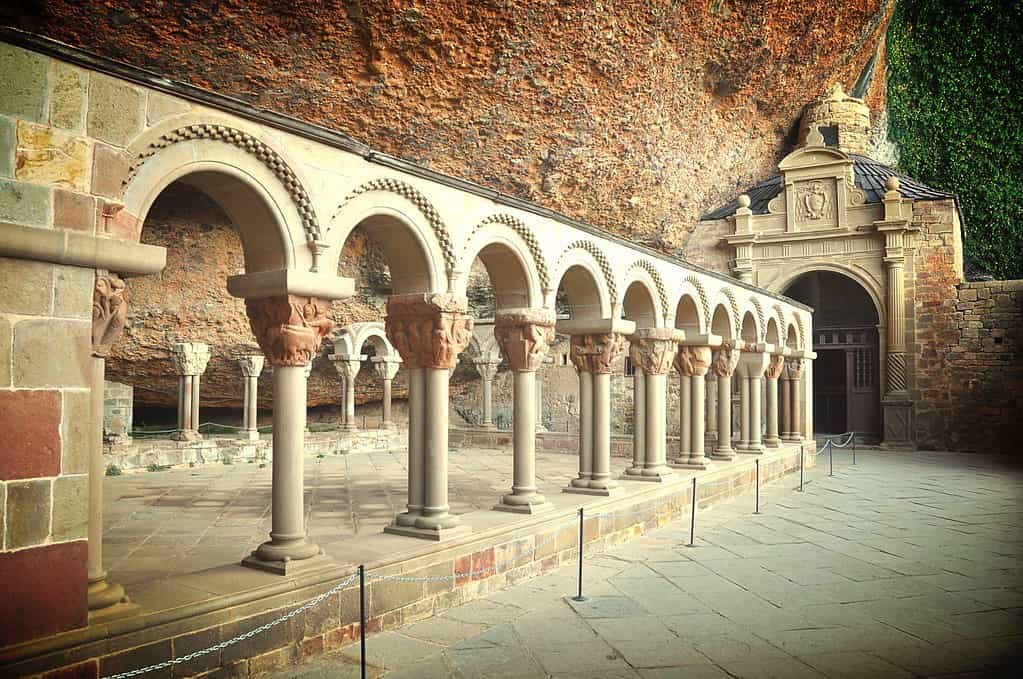
Perched on a cliff 1,000 meters above sea level, the Monastery of San Juan de la Peña is one of the most spectacular sites on the French Way. Although its origins date back to the 7th century, most of what you see today is Romanesque, built between the 11th and 12th centuries.
The cloister is a gem: its twin columns, finely crafted capitals, and Romanesque arches create a space of almost unreal beauty. Every corner invites contemplation. If you have the chance, climb to the upper church for breathtaking views.
The Collegiate Church of Roncesvalles
Roncesvalles is the meeting point between France and Spain. Its collegiate church, built in the 12th century, represents the transition between late Romanesque and the first hints of Gothic. The church, dedicated to Saint Mary, combines Romanesque solidity with details that anticipate Gothic elegance.
The cloister, though later (14th century), retains Romanesque elements that show how the styles coexisted for centuries. It is a place of transition, both geographically and architecturally.
The transition to Gothic: changes in the architecture of the route
Around the 12th century, something changed in the way medieval builders understood space and light. Gothic, born in France, arrived in the Iberian Peninsula with a revolutionary promise: to build higher, lighter, and more ambitiously. While Romanesque was the expression of solidity, Gothic was the expression of aspiration.
The French Way was one of the first places where Gothic took root in Spain. The cathedrals of Burgos and León are testimonies to this transformation. It wasn’t a sudden change, but a gradual one. For decades, both styles coexisted, influencing each other, creating a hybrid style that is distinctly Iberian.
Differences between Romanesque and Gothic along the route
If Romanesque impresses you with its solidity, Gothic will captivate you with its lightness. Where Romanesque uses round arches, Gothic employs pointed arches that seem to reach for the sky. Where Romanesque has thick walls, Gothic reduces them to the minimum necessary, allowing light to enter through enormous stained-glass windows.
The flying buttresses and ribbed vaults of Gothic are its secret: these external structures allow the walls to be thinner and the windows larger. It’s engineering at the service of spirituality. Romanesque makes you feel protected; Gothic makes you feel elevated.
Gothic gems on the French Way
The Cathedral of Burgos: the pinnacle of Spanish Gothic
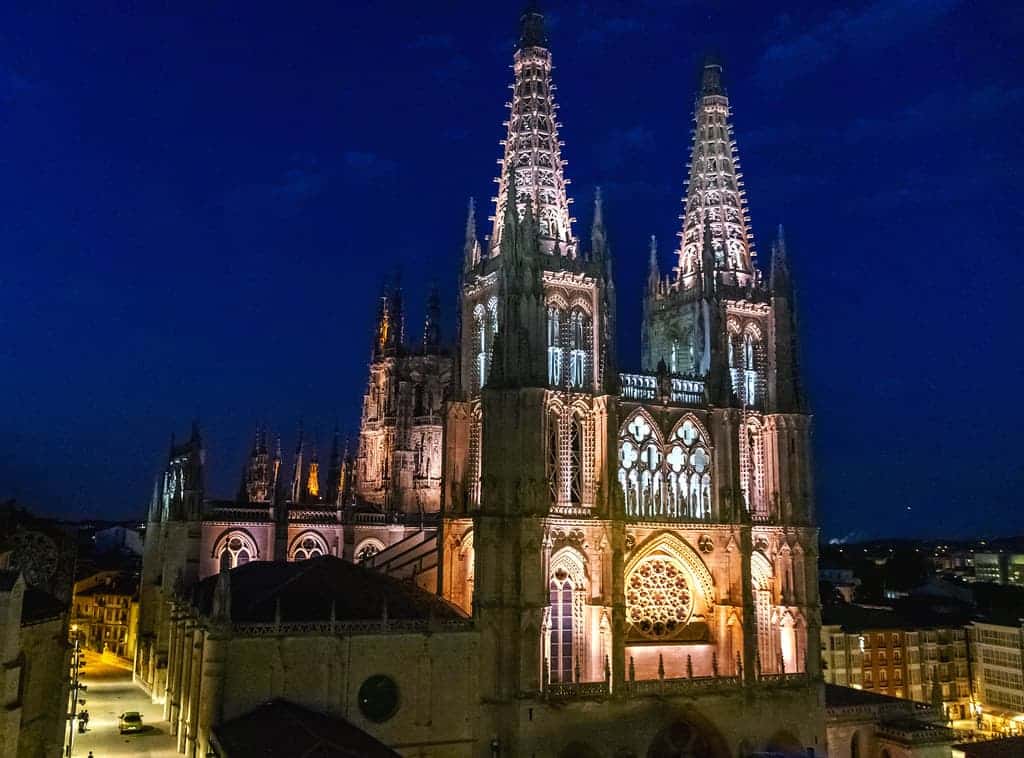
The Cathedral of Burgos is, without exaggeration, one of the most spectacular temples in all of Europe. Initiated in 1221, this cathedral is the benchmark of Spanish Gothic. Its twin towers, with their pierced spires, are visible from miles away and serve as a spiritual beacon for pilgrims.
What makes it unique is its evolution. It began as pure Gothic, but over the centuries, elements of Renaissance, Baroque, and even Neoclassical styles were added. It is an architectural palimpsest where each era has left its mark. The interior is equally impressive: its vaults seem to float, its columns rise to infinity, and the light that filters through the stained glass creates an almost mystical atmosphere.
The Cathedral of León: light and verticality
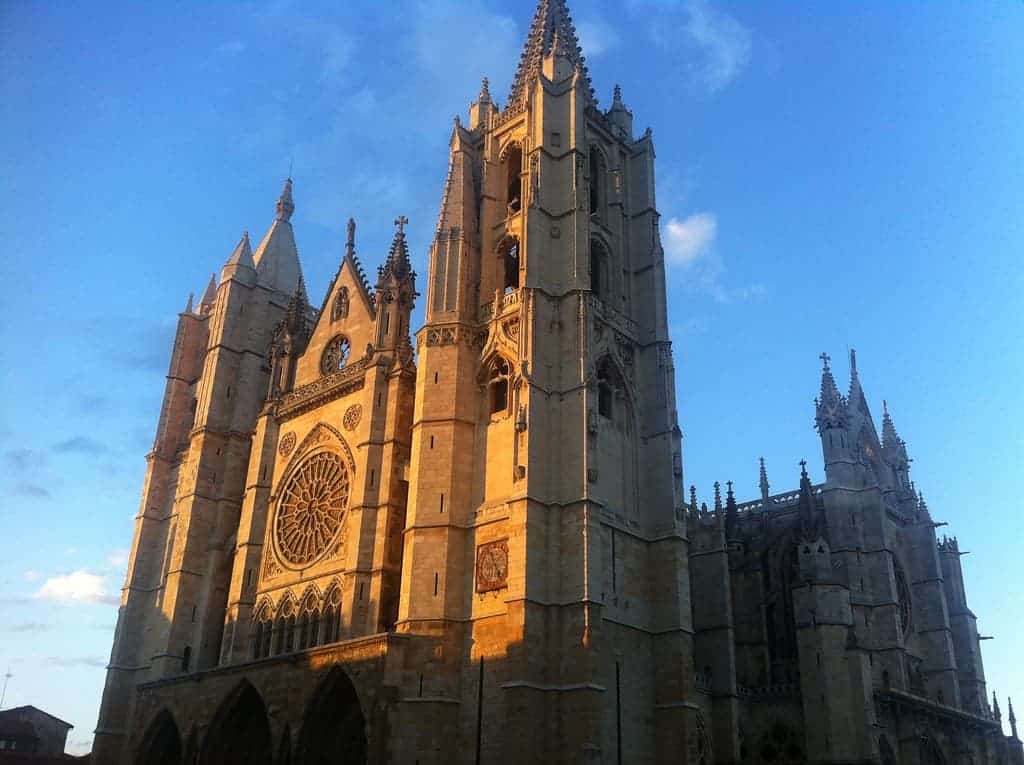
If Burgos is the expression of Gothic ambition, León is the expression of its poetry. The Cathedral of León, initiated in 1205, is a masterclass in how to use light as a building material. Its stained glass, some of the oldest in Spain, transforms sunlight into colour and emotion.
The interior is surprisingly bright for a medieval building. This is because its walls are thinner than those of other Gothic cathedrals, allowing light to penetrate deeply. When you enter, you’ll feel as if you’re inside a jewel of glass and stone.
The Church of San Isidoro in León
Although San Isidoro is mainly Romanesque, its evolution into Gothic is evident in its later chapels. This church, built between the 11th and 13th centuries, is a living museum of architectural transition. Its Royal Pantheon, decorated with Romanesque frescoes, is one of the most beautiful spaces in Spanish medieval art.
The Cathedral of Astorga
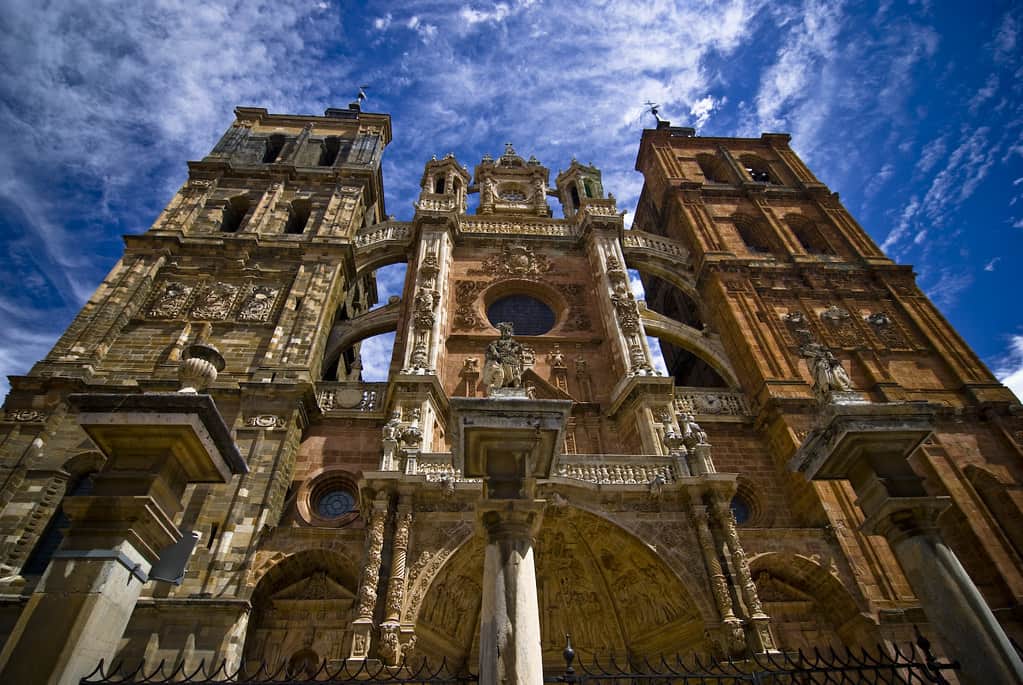
The Cathedral of Astorga, initiated in the 15th century, represents late Gothic. Although more recent than Burgos or León, its beauty is no less impressive. Its façade, with its towers and ornamental details, is a symphony of stone. The interior, though less luminous than León, has a serene elegance that invites contemplation.
Architectural comparison: other routes of the Camino de Santiago
Romanesque and Gothic heritage on the Portuguese Way
The Portuguese Way offers a different perspective on medieval heritage. Although less known, this route contains architectural gems that deserve your attention. You can find more details about the Oporto to Tui stages to discover how Romanesque and Gothic are expressed differently in Portuguese territory.
In Portugal, Romanesque has its own characteristics: it is more influenced by Islamic art and local building traditions. Portuguese churches tend to be more compact, more defensive, reflecting the reality of a kingdom that was constantly at odds with its neighbours.
Portuguese Gothic, for its part, is more ornamental, more decorative, influenced by artistic trends from Northern Europe.
Architectural treasures of the Spiritual Variant
The Spiritual Variant route is a less-travelled path that offers a more intimate experience of medieval heritage. This route passes through regions where late Romanesque and early Gothic coexist in a fascinating way.
Here you’ll find parish churches that don’t appear in the main tourist guides, but are equally valuable from an architectural standpoint. Built by local master builders, they show how the great architectural trends adapted to the realities of rural communities. Here, Romanesque is more austere and Gothic is more practical, but both are authentic.
Medieval art on the stages from Orense to Santiago (Sanabrés Way)
The Sanabrés Way, starting from Orense, is another route worth exploring. You can learn more about the stages from Orense to Santiago to plan a journey that allows you to discover the architectural heritage of Galicia from a different perspective.
In Galicia, Romanesque has a very distinct character. Influenced by French architecture but adapted to the Atlantic climate and local materials, Galician Romanesque is more sober, more functional. Galician churches tend to have simpler plans, but their decorative details are often more refined.
Galician Gothic, on the other hand, is later than in other regions, but when it arrives, it does so with full force, especially in the cathedrals of Santiago and Lugo.
For a full view of the Camino de Santiago heritage, it is essential to understand that each route offers a unique perspective on how medieval art developed in different geographical and cultural contexts.
How to make the most of your journey to discover these monuments
Strategic stops by stage
You don’t need to stray far from your route to visit these monuments. Most are directly on the French Way or just a few kilometres away. In your first week, from the Pyrenees to Puente la Reina, you’ll have the opportunity to visit Jaca, Loarre, San Juan de la Peña, and Roncesvalles. Take your time at each one; it’s not a race.
In Burgos, plan a stop of at least two days. The cathedral deserves more than one visit. Go in at sunset to see how the light transforms the interior. Climb the towers if you have the chance. Explore the cloister. The Gothic architecture of Burgos is so complex that every visit reveals new details.
León also deserves two days. In addition to the cathedral, you can visit San Isidoro. Walk through the medieval streets of the city. Feel like a 12th-century pilgrim when this city was one of the most important centres of Peninsular Christianity.
Tips for enjoying architectural heritage
Bring an architectural guide or download an app to help identify Romanesque and Gothic elements. This will transform your experience. Instead of just looking, you’ll understand what you’re seeing.
Visit the churches at different times of the day. The light changes, and with it, the atmosphere of the space. A church that seems sober at noon can appear magical at sunset when the light enters at an angle, creating dramatic shadows.
Talk to the caretakers and sacristans. They often have fascinating stories about their churches, details you won’t find in any book. They are the guardians of architectural memory.
The French Way as a medieval art gallery
The French Way is more than a pilgrimage route. It is a journey through the history of European medieval art. Every church you visit, every monument you contemplate, is a testament to the faith, ingenuity, and dedication of generations of builders, artists, and believers.
Romanesque teaches you solidity, permanence, and connection to the earth. Gothic teaches you aspiration, lightness, and the desire to touch the divine. Together, these two styles tell the story of how medieval humanity understood its place in the universe.
On your pilgrimage, don’t forget to look up. Observe the arches, the capitals, the stained glass. Every detail is a word in the universal language of architecture. And if you truly want to understand this language, consider exploring the other routes of the Camino de Santiago. Each one offers its own perspective, its own beauty, its own truth.
The French Way is the heart of this experience, but the entire Camino de Santiago is what will allow you to truly understand the richness of Iberian medieval heritage. May your pilgrimage be both a spiritual journey and a journey through the history of art.