Walking is a form of healing. When life suddenly halts due to the death of a loved one, a significant breakup, or a personal crisis, words sometimes fall short, but the body asks to move.
In this context, the Camino de Santiago becomes much more than an ancient route: it is a space for transformation, silence, companionship and, above all, a reunion with oneself.
Índice de contenidos
- 1 The Camino de Santiago as an Emotional and Spiritual Journey
- 2 Stages of Grief and Their Reflection on the Camino
- 3 The Importance of Silence and Companionship
- 4 Choosing the Right Route to Heal: Camino de Santiago Options
- 5 Personal Rituals and Tributes Along the Camino
- 6 The End of the Camino Is Not the End of the Process
- 7 Practical Advice for Pilgrims in Grief
The Camino de Santiago as an Emotional and Spiritual Journey
Although many people walk the Camino de Santiago for cultural, sporting, or religious reasons, more and more are choosing it as an experience of inner growth. Pilgrimage is not just about moving towards a geographic destination, but walking inward, exploring the soul, and making space for emotions that need to be felt.
After a loss, some find that life seems to lose its meaning. Grief disorients, disrupts routines, and shifts priorities. This experience, with its slow pace, changing landscapes, and openness to the unexpected, becomes a living metaphor for the process of rebuilding.
Furthermore, marking each day with a beginning and an end — a stretch that is started and completed — creates a contained structure, where pain can take shape without overflowing.
Walking, in this context, is more than just moving. It is a way of being present, of listening to the body, accompanying oneself without pressure. Physical fatigue often opens doors to emotions that were previously closed.
Stages of Grief and Their Reflection on the Camino
The emotions experienced during grief (denial, anger, sadness, acceptance…) are not linear. Many people describe their process as a back-and-forth between phases, sometimes even contradictory. The Camino de Santiago, by its very nature, supports this emotional oscillation.
There are days when the body feels heavy, memories hurt, and the mind fills with questions. On others, the beauty of the landscape, a casual conversation, or an unforgettable sunrise awakens a timid hope. This alternation is not only natural but profoundly therapeutic.
Moreover, walking long distances in silence activates deep psychological processes. Constant movement helps release tension, unlock emotions, and create new neural connections. It is no coincidence that many therapists recommend physical exercise and connecting with nature as part of emotional recovery.
The moments of introspection that arise spontaneously during pilgrimage help reframe what has been experienced. Many return with greater clarity about what they feel, what they need, and what they are willing to let go of.
The Importance of Silence and Companionship
One of the paradoxes of the Camino de Santiago is that it allows moments of absolute solitude, but also intense human encounters. And the best part is that both are equally valuable.
Many grieving pilgrims seek precisely this balance: to be with themselves without distractions, but also to feel human warmth at the right moments. It’s not uncommon to cross paths with someone who has lost a partner, a child, or a friend… and without any grand speeches, that encounter becomes a mirror in which to recognise yourself.
Sharing pain, even in silence, is relieving. This journey creates the perfect context for these connections to emerge naturally, without force. Sometimes a simple smile or a conversation while walking is enough to feel that you are not alone.
The Camino also teaches you to be silent without discomfort. The silent companionship of another pilgrim can be as powerful as a deep conversation. Feeling that someone walks beside you, even without speaking, is one of the most empathetic gestures one can receive.
Choosing the Right Route to Heal: Camino de Santiago Options
Not all routes are the same. Some are busier, others pass through solitary landscapes; some traverse bustling towns, others wind through forests, mountains, or quiet coasts. Choosing the right itinerary can make a big difference in the healing process.
French Way
It is the most traditional and popular route. From Roncesvalles or Saint-Jean-Pied-de-Port to Santiago, it crosses cities and towns of all sizes and varied landscapes. Its flow of pilgrims fosters human connection. Therefore, it can be the ideal choice if you seek social interaction, shared spirituality, and the opportunity to talk with others on personal journeys.
Northern Way
This coastal itinerary, running along the Cantabrian coast, offers sections of great natural beauty, including cliffs, beaches, and mountains. If you are looking for a reflective experience in a quieter environment, the stretch of the Camino de Santiago from Santander to Gijón can provide the serenity you need.
Portuguese Coastal Way
The version closest to the sea along the Portuguese route offers oceanic landscapes and a slower pace.
If you want to feel the vastness of the Atlantic while heading towards Santiago, the Portuguese Camino de Santiago from Porto to A Guarda can be a powerful choice. The sea, with its constant ebb and flow, symbolises the flow of life and is a great ally in releasing emotions.
The Camino from A Guarda to Santiago combines coastal and inland sections, allowing a transition between landscapes that also reflects the pilgrim’s inner process. It is ideal for those seeking spiritual connection and natural beauty.
Other Routes
- Primitive Way: more physically demanding, but with high mountain scenery that fosters introspection. It requires mental strength and can be a powerful metaphor for emotional effort.
- Vía de la Plata: from Seville, crossing the peninsula from south to north, ideal for those who need time and space. It is usually less crowded.
- English Way: from Ferrol or A Coruña, short but intense. Perfect if you have fewer days or prefer a more contained environment.
Each of these routes can be adapted to your needs depending on your current life stage. You can find information and plan effortlessly through platforms like Mundiplus, specialists in Camino de Santiago trips, which facilitate organisation without compromising the spontaneity of the journey.
Personal Rituals and Tributes Along the Camino
The Camino de Santiago has also become a space for tribute. Many people carry a photograph, a letter, or a symbolic item of the deceased. Others leave a stone in places such as the Cruz de Ferro (Iron Cross), one of the most symbolic points along the route, where thousands of pilgrims deposit objects representing emotional burdens.
Writing in the albergue books, sharing memories with fellow walkers, or simply remaining silent while gazing at a landscape are gestures that, though seemingly small, carry immense value. Each step becomes a tribute, each stage a farewell, and each arrival a welcome to a new chapter in life.
Some also perform small rituals upon reaching Santiago: lighting a candle, writing a letter and then burning it, leaving an object in the Cathedral, or even continuing to Finisterre to throw a symbolic stone into the sea.
The End of the Camino Is Not the End of the Process
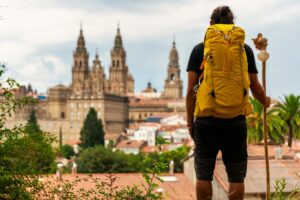
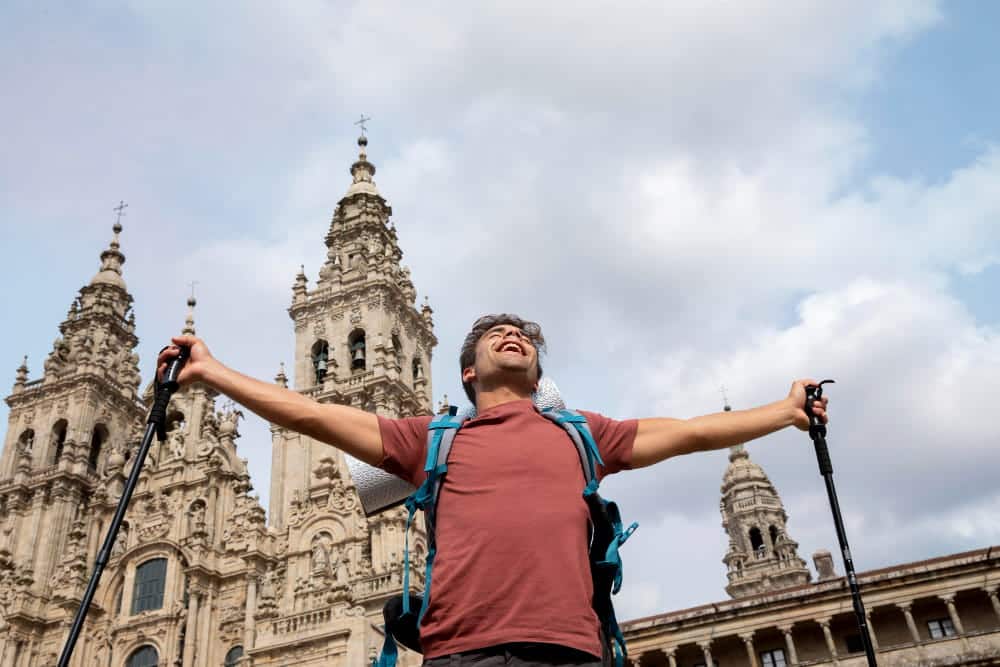
Arriving at the Plaza del Obradoiro and seeing the Cathedral of Santiago moves one to tears. It is undoubtedly a significant milestone. But it can also awaken a certain sense of emptiness: what now?.
Grief does not end in Santiago. Yet many people say that they return with a new perspective, more at peace, more connected with themselves and with their experiences. The important thing is to take what you have learned and give a place to the memory, without it weighing you down or holding you back.
Some pilgrims choose to continue to Finisterre or Muxía, symbolically closing the cycle by the ocean. There, the sea invites release, gratitude, and looking toward the horizon.
Returning does not mean forgetting, but integrating. Reaching the end allows acceptance that love does not disappear, it transforms.
Practical Advice for Pilgrims in Grief
If you are considering walking the Camino after a loss, here are some recommendations that may help:
- Listen to your rhythm. Don’t compare yourself to others. Take shorter stages if needed. There is no rush.
- Take care of your rest. Choose quiet accommodations that encourage sleep and privacy. Or better yet, let us take care of finding your place to rest.
- Speak if you feel like it, stay silent if you prefer. No one will judge you for walking in silence or for sharing your story.
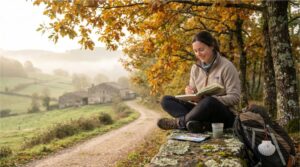
- Write. Bring a notebook. Sometimes putting experiences into words clarifies and liberates.
- Travel light. Neither in luggage nor in guilt. You can also let us transport your backpack so you can walk lighter.
- Carry a symbolic object. It could be a letter, a photo, or a stone to leave in a special place.
- Choose the right season. Spring and autumn offer mild temperatures and fewer people, ideal for those seeking tranquility.
- Trust the Camino. Sometimes what you need does not need to be sought; it finds you while walking.
Pain does not disappear by walking the Camino de Santiago, but it can transform. Walking after a loss is a way to honour what has been lived, to give thanks for what has been shared, and to begin a new chapter. Along the kilometres, the soul finds order, the heart finds solace, and the body remembers it is alive. And in the midst of sorrow, that is a huge step forward.