Walking the Camino de Santiago is a life-changing experience. Since the Middle Ages, it has been a journey of faith, introspection, and human connection. But in recent years, the pilgrim profile has evolved. Alongside spiritual or sporting motivation, a new figure has emerged: the digital nomad, someone who works from anywhere in the world with just a laptop and an Internet connection.
The question naturally arises: can remote work be combined with the Camino experience? At first glance, these may seem like opposing worlds, but in reality, with proper planning, it is possible to combine both. That said, it’s not a decision to be taken lightly.
Índice de contenidos
- 1 The Camino de Santiago as a hybrid experience: spiritual, physical… and professional?
- 2 Basic requirements for remote working while walking
- 3 Comparison of Camino routes and their suitability for digital nomads
- 4 Which jobs suit this experience best?
- 5 Advantages and challenges of working while walking the Camino
- 6 Useful tips for remote working on the Camino
- 7 Better to work during the Camino or after reaching Santiago?
- 8 Get advice from those in the know
The Camino de Santiago as a hybrid experience: spiritual, physical… and professional?

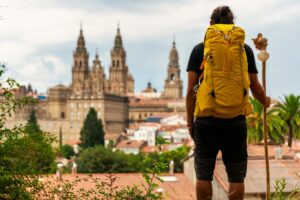
Walking the Camino involves covering between 15 and 30 kilometres a day, often under the sun or rain, with challenging climbs and long stretches that test both mind and body. But it also means disconnecting from daily noise, connecting with yourself, and meeting other pilgrims who, like you, are seeking something different.
However, the rise of remote work has transformed how we think about mobility. Marketing professionals, programmers, graphic designers, or writers can now fulfil their work responsibilities from a café in Burgos, a hotel in Lugo, or a rural house in Pontevedra.
But… is this feasible while walking every day? Yes, although not for everyone.
Basic requirements for remote working while walking

Reliable internet connectivity
Nowadays, mobile networks (4G and 5G) cover much of Spain and Portugal, especially in urban areas and medium-sized towns. However, some rural or mountainous stages still have low coverage areas. Before setting off, check your carrier’s coverage maps or consult forums from recent pilgrims.
Additionally, not all accommodations guarantee fast or stable WiFi. Private lodgings usually offer better connectivity than public ones, but it’s worth checking before booking.
Suitable spaces for focus
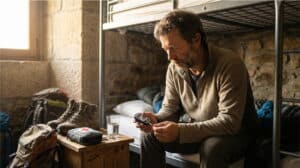
Similarly, not all Camino accommodations are suitable for comfortable work. Some have common areas where you can set up a “makeshift office,” while others are high-traffic spaces, noisy, or with few power outlets.
You might also consider booking a night in hostels with private rooms, small rural hotels, or accommodations with coworking areas (increasingly common on the French or Portuguese routes).
Physical and mental energy
This is a key point. After hours of walking, your body will likely just crave a shower, a hot meal, and rest. Working after a demanding stage is not always easy. That’s why many pilgrims who work choose gentler routes, intersperse rest days, or plan shorter stages.
Lightweight and functional gear
The lighter and more compact your equipment, the better. A small laptop or tablet with a keyboard, external batteries, noise-cancelling headphones, and multi-charging adapters will be your best allies.
Comparison of Camino routes and their suitability for digital nomads
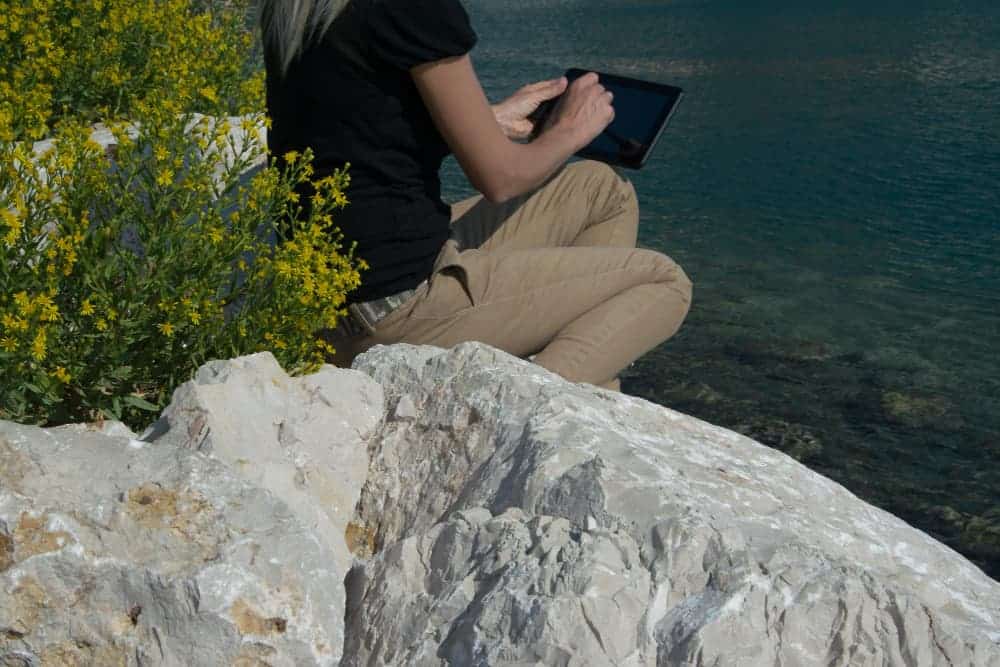
Each Camino de Santiago route has different characteristics in terms of coverage, accessibility, and services. If your goal is to work remotely while walking, it’s important to choose a route that makes your life easier.
French Way (Camino Francés)
- Advantages: it is the most popular route with the best infrastructure. Coverage is good along most sections, and it’s easy to find accommodations with WiFi, restaurants with power outlets, and supermarkets.
- Ideal for: those who don’t want logistical complications and want to combine gentle stages with workdays.
Northern Way (Camino del Norte)
- Advantages: offers spectacular landscapes, coast and mountains, and passes through major cities like Bilbao, Santander, and Gijón.
- Disadvantages: connectivity can fail in more isolated areas.
Interested in walking along the Cantabrian coast while working online? Discover the details of the Camino de Santiago from Santander to Gijón and plan your stages with reliable connectivity.
Portuguese Way (Camino Portugués)
- Advantages: good infrastructure, variety of accommodations, gentle stages, and cities with all types of services (Porto, A Guarda, Vigo, Pontevedra).
- Highly compatible: ideal for digital nomads due to its combination of accessibility, scenery, and services.
If you choose the Coastal Portuguese Way, this route allows you to combine remote work and adventure. The Portuguese Way from Porto to A Guarda offers good infrastructure and unique landscapes.
Want to finish the Camino with comfort and available WiFi? Check the section of the Camino from A Guarda to Santiago to complete your adventure without disconnecting.
Primitive Way (Camino Primitivo)
- Advantages: wild nature and solitude.
- Disadvantages: tough stages and limited connectivity. Not recommended for remote work unless you can work offline and occasionally.
English Way and Vía de la Plata
- Variable coverage: in cities like Ferrol, A Coruña, or Ourense you’ll find sufficient services, but rural stretches may make daily connection challenging.
Which jobs suit this experience best?
If your work allows you to manage your time and doesn’t rely on constant meetings, you can consider working while walking the Camino. These professions are most compatible:
- Writers, translators, and proofreaders.
- Graphic or web designers.
- Community managers and digital marketing professionals.
- Freelance programmers or developers.
- Online language teachers (with well-distributed classes).
Avoid jobs with constant video calls, daily urgent deadlines, or heavy reliance on synchronous teamwork.
Advantages and challenges of working while walking the Camino
Advantages
- Complete break from routine: living on the move stimulates creativity and improves wellbeing.
- Flexible schedule: you can adapt your workday to your peak energy times.
- Inspiration: landscapes, slow pace, and conversations with other pilgrims spark new ideas.
Challenges
- Lack of rest: poor time management can leave you physically and mentally exhausted.
- Irregular coverage: though less frequent, some areas still lack mobile signal.
- Unpredictable pace: if you rely on deadlines or fixed schedules, the Camino can complicate your agenda.
Useful tips for remote working on the Camino
- Choose accessible routes with good coverage.
- Plan shorter stages (15–20 km) to conserve energy, even if it takes longer to reach Santiago Cathedral.
- Book accommodations with good connectivity and quiet spaces.
- Carry offline work apps (text editors, spreadsheets, task managers…).
- Rest well: don’t underestimate the importance of sleep and recovery.
- Don’t overdo it each day. Sometimes, less is more.
Better to work during the Camino or after reaching Santiago?
Some people prefer to separate the experiences: they walk the Camino without working and then spend a few days in Santiago to catch up. It’s a good option if you want to fully experience the Camino without work distractions.
Others combine both wisely: working on rest days or only in the afternoons. The key is knowing yourself, listening to your body, and being flexible.
Get advice from those in the know
Working while walking the Camino de Santiago is not only possible but can become one of the most enriching experiences of your professional and personal life. That said, it requires organisation, adaptability, and, above all, a realistic approach.
Walking, reflecting, getting inspired… and working. Everything fits on this millennial route, as long as you go at your own pace and with purpose.
There are specialised resources to make life easier, from booking accommodations to transporting your luggage. There are companies for walking the Camino de Santiago like Mundiplus that help you organise your trip hassle-free.
Why get professional support if you’re remote working on the Camino?
If you plan to combine the Camino with your professional activity, specialised support can make a big difference. At Mundiplus we help you whenever possible with accommodation in comfortable places with connectivity, manage luggage transfers, and offer route assistance. That way, you can focus on walking, resting, and working with peace of mind.