The Camino de Santiago is often recounted through cathedrals, bridges, hospitals, roads, and landscapes. But there is another “infrastructure” that also explains the Jacobean phenomenon: funerary spaces.
Sources state it, archaeology confirms it, and the places themselves whisper it: for centuries, walking to the destination of Santiago de Compostela meant facing exhaustion, illness, cold, and accidents in rural or mountainous areas; and when a pilgrim died—on the route or upon arrival—the local community and its hospitality institutions took on a material, spiritual, and social obligation: to provide a “worthy burial”.
Of course, this does not turn the Camino into a story of tragedies, but into a complete history. Cemeteries and “fosales” (churchyard burial atriums), ossuaries or charnel houses associated with hospitals, and later, the extramural cemeteries of the contemporary period (outside temples and town centres) are all part of the same cultural network that helped make pilgrimage possible.
To place the general context of the route and its historical evolution, on the Mundiplus blog you can consult a comprehensive overview at the link history of the Camino de Santiago. This article focuses on what cemeteries preserve: traces of hospitality, health crises, changes in attitudes towards death, and, above all, memory.
Índice de contenidos
- 1 Pilgrimage and Death: the Role of Hospitals, Churches, and Jacobean Symbols
- 2 From the Churchyard to Extramural Cemeteries: a Transformation that Also Affected the Camino
- 3 Recommended Cemeteries and Funerary Spaces Along Jacobean Routes
- 4 How to “read” a Jacobean cemetery: orientation, symbols, and traces of the journey
- 5 Conservation, memory, and a simple visitor ethic
Pilgrimage and Death: the Role of Hospitals, Churches, and Jacobean Symbols
The logic of the medieval and early modern Camino was eminently practical: one had to eat, sleep, heal… and also die “well”, in a Christian and communal sense.
Hospitals were not just shelters: they were part of an assistance and spiritual system that included chapels, confraternities, and rules for attending sick travellers. When the end came, burial was not an afterthought: it formed part of the acts of mercy that justified and sustained the hospital institution.
A particularly striking example is the “charnel house” (ossuary) linked to the Royal Collegiate Church of Santa María de Roncesvalles. Archaeological and historical studies on burials here highlight that if a pilgrim died, it was also the hospital’s duty to provide a burial. The phrase “the charnel house… in the Chapel of the Holy Spirit” is explicitly cited as a notable example of this practice.
This funerary dimension also appears in urban archaeology. In Jaca, the excavation of the medieval cemetery identified in Plaza Biscós documents a large number of burials and allows precise descriptions of rituals and typologies: oriented graves, reuse of tombs, ossuaries, and superimpositions accumulated over centuries. In such contexts, one element provides a very specific Jacobean clue: the scallop shell of the pilgrim, found in necropolises linked to the route.
Here, a useful principle for reading Camino cemeteries comes into play: the pilgrim sign is not always on a “spectacular” monument, but in small evidences (a symbol, an orientation, an inscription, an object). At Plaza Biscós, it is explained that the “notable milestone on the Camino” and the flow of foreign visitors form part of the context that helps interpret the funerary space.
And in Compostela, historical studies place a cemetery specifically connected to the pilgrimage—linked to the hospital and a now-disappeared chapel—where the urban topography itself ended up covering and transforming the site.
As a backdrop, it is worth remembering that the route is not a simple linear itinerary: it is a cultural landscape made up of routes and “built heritage” created to meet the needs of pilgrims (churches, hospitals, hostels, bridges, etc.). This same logic allows us to consider historic Camino cemeteries as part of the infrastructure that supported the journey.
From the Churchyard to Extramural Cemeteries: a Transformation that Also Affected the Camino
Camino cemeteries are not just medieval. In fact, many of the most visible ones today in Jacobean cities stem from a decisive transformation: the shift from burials within churches or their immediate vicinity to those outside the urban core.
In Enlightenment-era Spain, funerary reform was linked to hygienic and sanitary concerns and critical incidents. A study on funerary mentalities explains that a turning point was the 1781 epidemic in Pasajes, associated with the “intolerable stench” of a parish due to accumulated corpses. As a result, the Royal Decree of 3 April 1787 was enacted, ordering the restoration of “ventilated cemeteries” outside towns.
The same study highlights that the measure met with resistance and its effectiveness was uneven, requiring subsequent initiatives to consolidate it.
Why does this matter for the Camino? Because many Jacobean towns—especially cities—reorganised their funerary spaces in the 19th and 20th centuries. Thus, modern pilgrims encounter “modern” (extramural) cemeteries which, although not medieval, are historical in a heritage sense: reflecting funerary architecture, collective memorials, neighbourhoods of different confessions, and lists of notable burials that tell the cultural and political history of each place.
Moreover, this “valorisation” of funerary heritage—cemeteries as places of memory and urban spaces—is a relatively recent phenomenon. A study on the pilgrim cemetery in Compostela recalls the emergence of associations dedicated to funerary heritage. It mentions academic interest in integrating former cemeteries into public parks, as occurred with the old Santiago cemetery incorporated into Bonaval Park in the early 1990s.
On the Camino, therefore, at least three layers coexist:
- Medieval or early medieval cemeteries (often archaeological, under squares or next to cathedrals).
- Fosales and parish cemeteries (next to churches, with historical continuity).
- Contemporary extramural cemeteries (19th–20th centuries), with municipal and heritage purpose.
This mixture is precisely what makes the funerary reading of the Camino so rich.
Recommended Cemeteries and Funerary Spaces Along Jacobean Routes
This section proposes examples with solid documentation, spread across various routes. It does not attempt to list everything (which would be impossible), but aims to offer a “memory map” to help understand how each itinerary leaves its funerary mark.
French Way
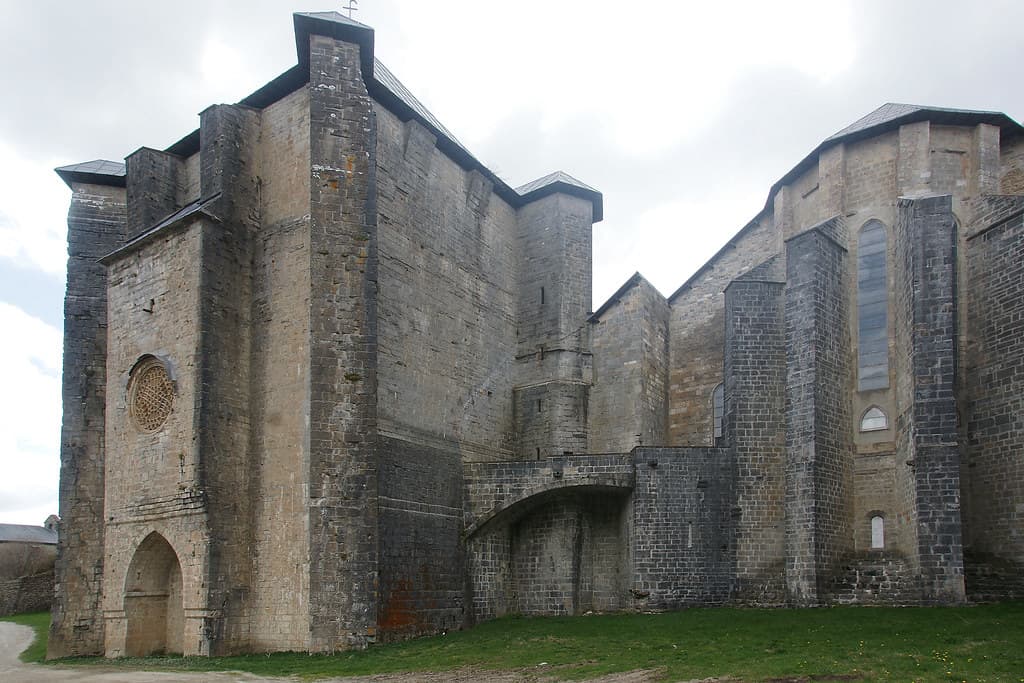
On the French Way, the Pyrenean frontier concentrates one of the most direct relationships between pilgrimage, risk, and burial. At the start of the route, it is described how crossing the Pyrenees involved dangers (snowstorms, animals, bandits) and how this reality motivated the construction of a hospital for pilgrims in Roncesvalles in 1127.
Overall, the chapel also known as Charlemagne’s Granary is interpreted as a funerary space: masses for deceased pilgrims were held there, and an ossuary existed. The continuity of memory is emphasised by the fact that the complex functions as both a municipal and collegiate cemetery and houses remains linked to the Camino.
Moving towards Estella-Lizarra, another significant case is the Church of San Pedro de la Rúa. During the Middle Ages, this church was used as a pilgrim cemetery, and in the 13th century, a bishop from Patras carrying a relic of Saint Andrew was buried there. It is a perfect example of how the route did not just generate transit: it also generated memory and “remains”, geographically connecting distant worlds.
Going back to Aragón, the case of the “main cemetery” of Jaca is key to understanding the Camino from an archaeological perspective. The study of the medieval necropolis associated with Plaza Biscós explains that the excavation identified 877 burials, making it one of the largest medieval cemeteries excavated in Aragón at the time. The study also details a structural typology of graves, the importance of ossuaries, and the uniform Christian ritual within a space reused over centuries.
For those covering stages in La Rioja and Castilla, it can be useful to view the route as a territorial continuity, even if the most “direct” funerary examples (hospitals-ossuaries, cemeteries specifically for pilgrims) are less visible at first glance.
- If the starting point is Logroño, the stage planning can be consulted on the French Way route from Logroño. And if the start is Burgos, the equivalent reference is the French Way route from Burgos. In both stretches, the key interpretive point is to remember that many “modern” city cemeteries originate from the historical shift to extramural grounds (18th–19th centuries), a transformation that also reorganised the Jacobean cities.
Northern Way
Among the major urban stops in the north, the Ciriego Cemetery stands out for its ability to illustrate the transition to extramural cemeteries: its origin is explicitly linked to the Royal Decree of 1787 and to the hygienic-sanitary measures that promoted cemeteries outside city limits.
Its chronology notes that it was designed by Casimiro Pérez de la Riva in 1881 and inaugurated on 3 September 1885. The heritage description explains its cruciform layout (for symbolic and functional reasons) and subsequent efforts to catalogue and preserve mausoleums and pantheons of historical and artistic interest.
The Northern Way provides particularly clear examples of heritage cemeteries, especially in coastal cities from the Galician border onwards. If you follow the Northern Way route from Gijón, the itinerary enters through Ribadeo with signage and references to the scallop shell.
Original Way
The Original Way, considered “the first pilgrimage route, the oldest”, links Oviedo with Santiago and is associated with the journey of Alfonso II the Chaste in the first third of the 9th century. Many of its medieval funerary spaces are today less “accessible” as cemeteries. Nevertheless, evidence of burials connected to the Jacobean culture appears archaeologically through finds such as the scallop shell in cathedral contexts, including Oviedo Cathedral.
Portuguese Way
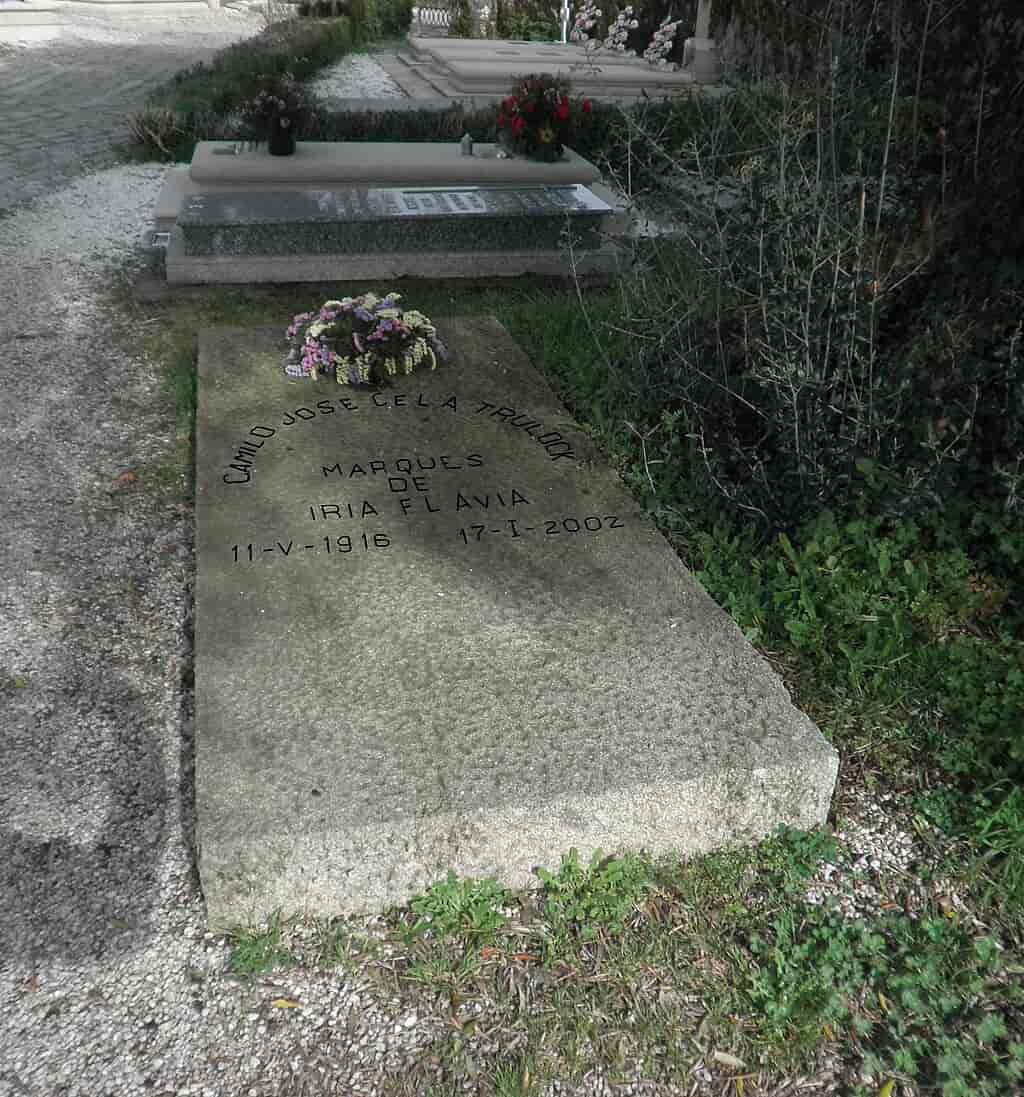
On the Portuguese Way, an essential site to understand the link between cemetery, literature, and memory is the Adina Cemetery, near Iria Flavia and Padrón. Municipal tourism documentation notes that the grounds around the church were used as a burial place since ancient times and that there are archaeological remains from the Roman and Suebi periods.
There are also 6th-century anthropomorphic sarcophagi in the atrium, catalogued cruceiros and centenary olive trees, and the grave of Nobel laureate Camilo José Cela.
A complementary reading, from the Jacobean stage narrative, emphasises the “beautiful cemetery… and the very ancient tombs surrounding the temple”, highlighting its significance within the pilgrimage route itself. From a cultural memory perspective, it is noted that Rosalía de Castro expressed her wish to be buried there, where her remains stayed until 1891 when they were transferred to the Pantheon of Illustrious Galician Men and Women at the Convent of Santo Domingo de Bonaval.
In other words: a cemetery beside the Way, but also an emotional archive of Galicia.
English Way

In the city of A Coruña, the San Amaro Municipal Cemetery stands out. Inaugurated in 1813 “after burials in churches and their surroundings were banned the year before”, it has been part of the European Cemeteries Route linked to the ASCE since 2013. Its division into three zones (religious, civil, and British) is described, and key figures of Galician culture and politics buried there are listed, such as Manuel Curros Enríquez, Eduardo Pondal, and Wenceslao Fernández Flórez.
It is, in itself, a contemporary “pantheon” of A Coruña, and a reminder that the Way also connects with civil history.
Way to Fisterra
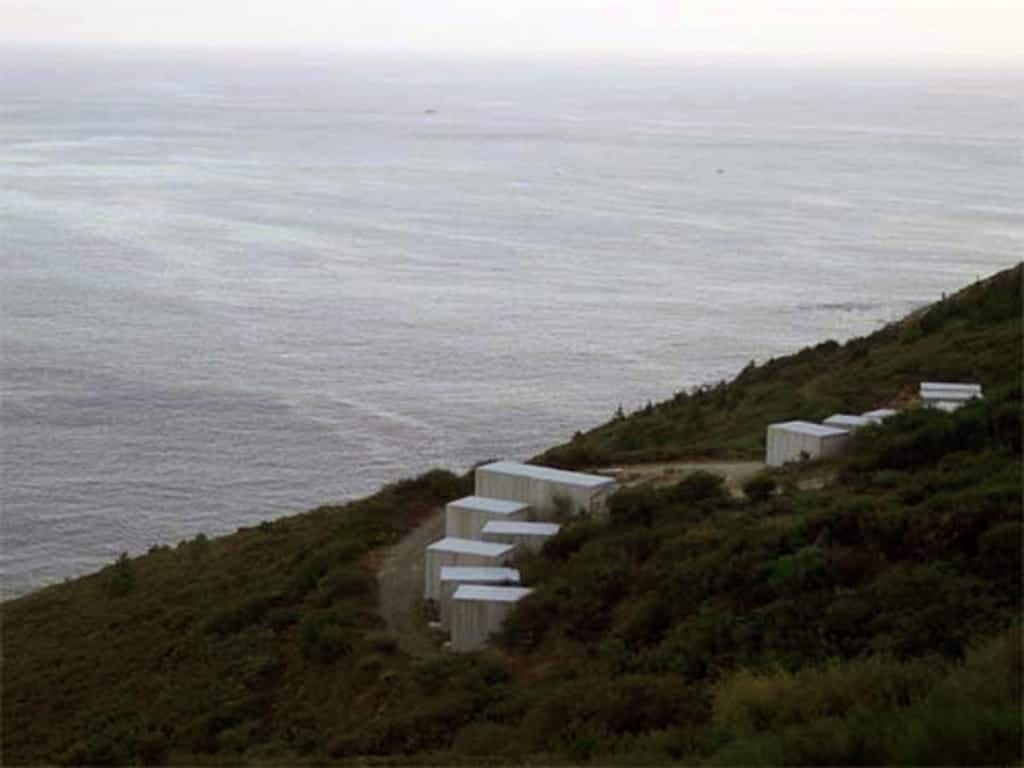
At that “end of the world” is the Fisterra Civil Cemetery, designed by César Portela between 1997 and 1999. Although a contemporary work, it remains revealing: it is conceived as a network of paths over the cliff, without enclosures, with the sea as a backdrop, moving away from the concept of a “walled” necropolis.
Municipal reactivation of the space as a columbarium for ash urns after years of neglect has also been documented. From a Jacobean perspective, it functions as a modern metaphor: the Way continues to produce places of memory, even today.
The English Cemetery
Although it does not strictly belong to the Fisterra and Muxía Way, it is very close to that vast Jacobean Atlantic territory of the Costa da Morte. It can be considered a complementary visit for anyone in the area wishing to broaden the historical perspective of the journey.
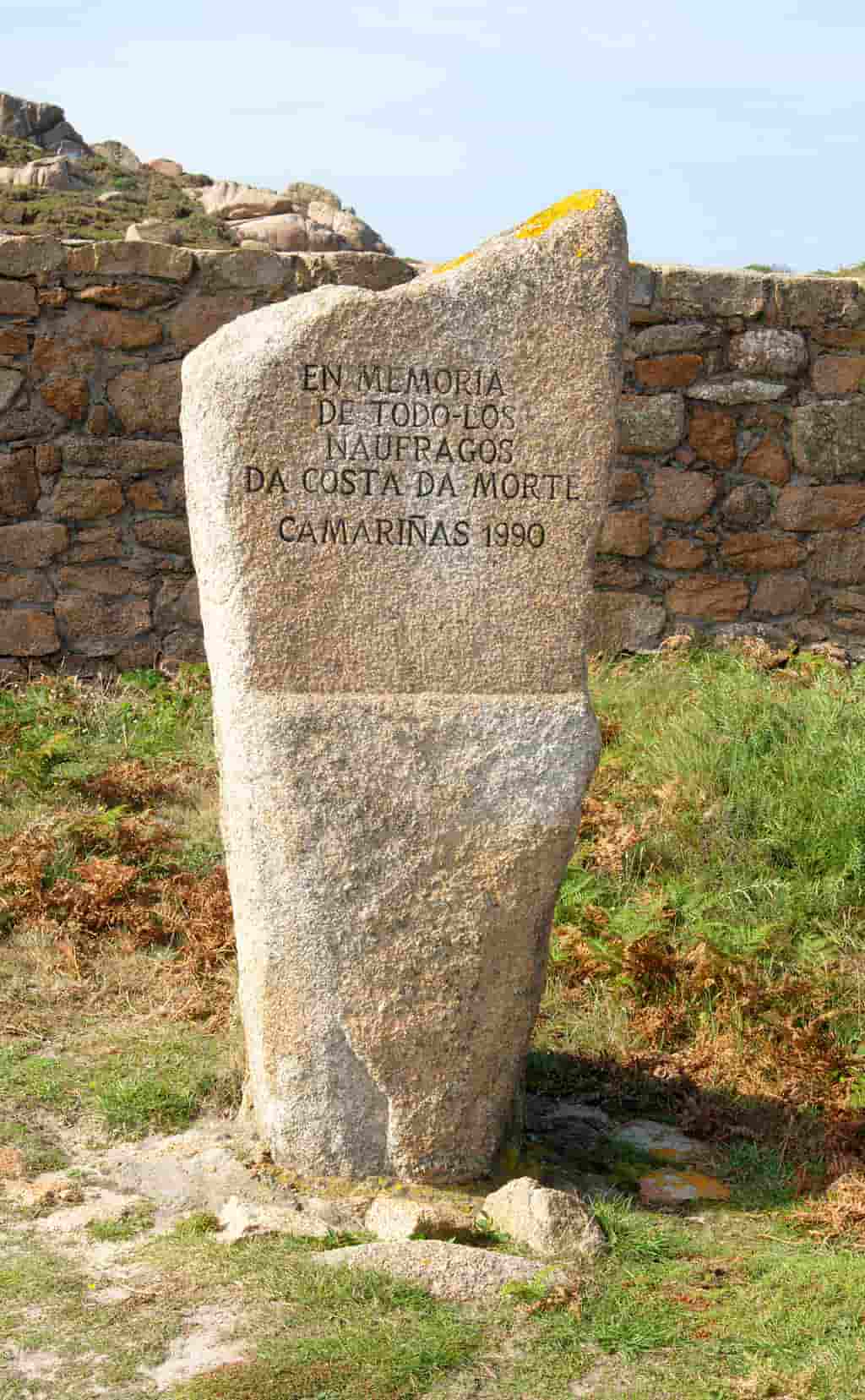
It is located in the municipality of Camariñas, in the parish of Xaviña, and its origin is not linked to the medieval pilgrimage, but to one of the most remembered shipwrecks on the Galician coast: the British ship The Serpent, sunk on 10 November 1890. The site contains the remains of the sailors drowned in the disaster and notes that it was the priest of Xaviña who mobilised the local population to give them burial.
The site has become one of the most unique cemeteries in Galicia. It is a stone memorial raised by the wreck of The Serpent and is the only cemetery exclusively for shipwreck victims.
In terms of landscape, its location explains much of its impact: it is in an open and rugged environment, close to Trece Cove and Monte Branco, in a zone where the landscape, the wind, and the memory of the sea form almost a single narrative. Therefore, although not strictly a Jacobean cemetery, it fits well into a broad reading of the Atlantic end of the Way: it does not speak of deceased pilgrims, but of the historic relationship with the coast.
How to “read” a Jacobean cemetery: orientation, symbols, and traces of the journey
Beyond a list of specific sites, there are common keys that help recognise what makes a historic cemetery “Jacobean”.
The first is the Christian ritual of orientation. At Jaca’s Main Cemetery, it is explicitly noted that all observed graves shared orientation, following the rite of placing the head to the west and the feet to the east; body positions and variants (for example, arm placement) are described. This regularity is important as it allows cemeteries to be identified as liturgical and community spaces, even when the structures are humble.
The second key is reuse and historical density. In Jaca, it is explained that due to crowding and prolonged use of the same space, reuse of burial structures was common, with secondary bone deposits and layering.
The third is the pilgrim symbol. The finding of scallop shells in necropolises along the route is treated as a documented pattern: cited in diverse contexts (from Roncesvalles to cathedral surroundings), this material presence directly connects the deceased to the pilgrimage.
The fourth key is the relationship with hospitals and chapels. If a pilgrim died, the hospital had to provide burial, and the Roncesvalles ossuary is presented as one of the best examples of this act of mercy. That is, the cemetery is not an isolated place: it is part of the reception ecosystem (hospital-chapel-cemetery).
The fifth key is urban transformation and neglect. The case of the Compostela pilgrims’ cemetery is exemplary: it existed from at least the 12th century, linked to the hospital and a now-disappeared chapel; in the 16th century it passed to the Royal Hospital and a second chapel was built; by the 19th century, hygienist measures and urban pressure pushed it into neglect; and in 2009 a landscaping intervention was carried out promoted by the Historic City Office.
Conservation, memory, and a simple visitor ethic
Viewing the Camino cemeteries is not “morbid” nor macabre tourism in itself; if approached correctly, it can be a form of historical understanding. Today, there is a movement to value funerary heritage that promotes inventories, master plans, and conservation networks.
In Ciriego, a systematic work of cataloguing and heritage protection (inventory, records, protection categories) is described, aimed at preserving the historical-artistic value of the site. In San Amaro, its link to European cemetery networks is explicitly noted, framing it as cultural heritage. In Santiago, the integration of an old cemetery into a public park shows how the contemporary city negotiates memory and urban use.
In practical terms, the visitor ethic is simple: silence, respect, do not intrude on private spaces, do not photograph people without permission, and remember that many cemeteries remain places of mourning. This does not limit historical reading; it enhances it. If the Way is, as UNESCO reminds, a network of built and cultural heritage created to sustain the pilgrimage, these cemeteries are part of that same legacy.
In the end, the Camino’s historic cemeteries reveal a truth that is not “epic” but deeply human: the journey did not always have a return, and precisely for that reason the reception sites — hospitals, churches, cities, and villages — learned to care also for those who did not make it.