The Kumbh Mela is recognised as the largest religious gathering on the planet. It is a sacred Hindu festival that brings together tens or even hundreds of millions of pilgrims in each edition. It far surpasses any other known pilgrimage (for example, the Hajj to Mecca welcomes around 1.8 million worshippers each year).
Below, we will explore what the Kumbh Mela is and what it consists of, its origins and history, the particularities of its practice, and how this massive phenomenon compares with the Camino de Santiago. This comparison will help us understand the differences and similarities regarding difficulty, route, preparation, and the spiritual significance of both pilgrimage experiences.
Índice de contenidos
What is the Kumbh Mela?
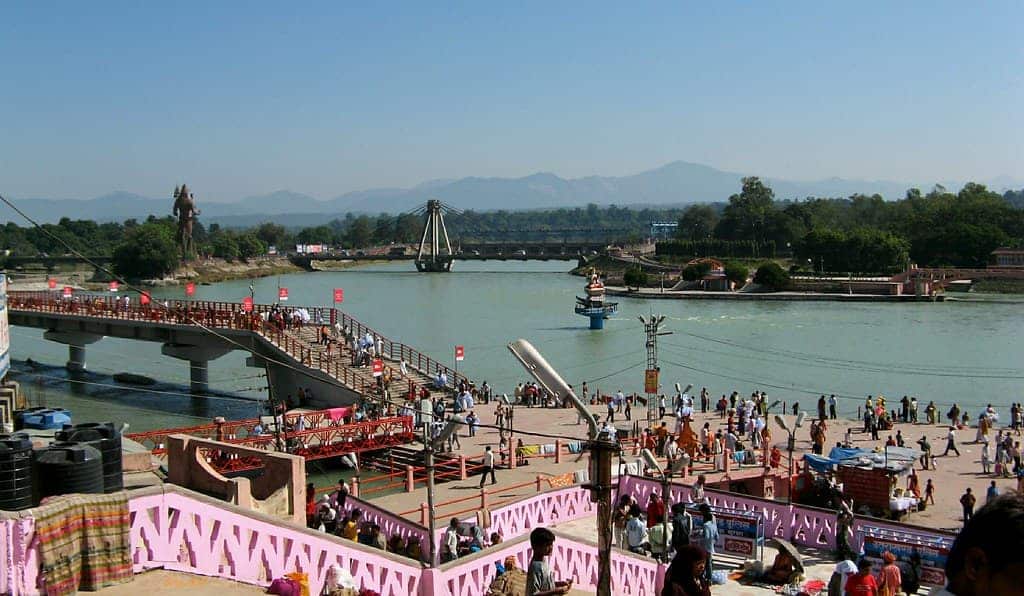
The Kumbh Mela (literally, “festival of the pitcher”) is an ancient Hindu religious festival celebrated on a rotating basis in four sacred locations across India. During the festival dates, millions of devotees spontaneously travel there to bathe in the waters of sacred rivers (mainly the Ganges and its confluences) in the belief that doing so purifies their sins and liberates them from the cycle of reincarnation.
In 2017, this festival was inscribed on UNESCO’s List of the Intangible Cultural Heritage of Humanity due to its immense spiritual and cultural significance.
Each celebration lasts several weeks (around 45 days in the largest editions) and involves daily rituals of dawn ablutions. The most important moment is the mass bathing in the sacred river on astrologically auspicious days.
Pilgrims—men, women, the elderly, the young, ascetic sadhus dressed in orange or even naked and covered in ash (the famous naga sadhus)—immerse themselves in the cold water convinced that the sacred bath washes away their sins and brings them closer to moksha (spiritual liberation). This immersion at the confluence of rivers (known as Sangam when the Ganges, Yamuna and Saraswati meet) is the central and most symbolic act.
Mythical origin and history of the Kumbh Mela
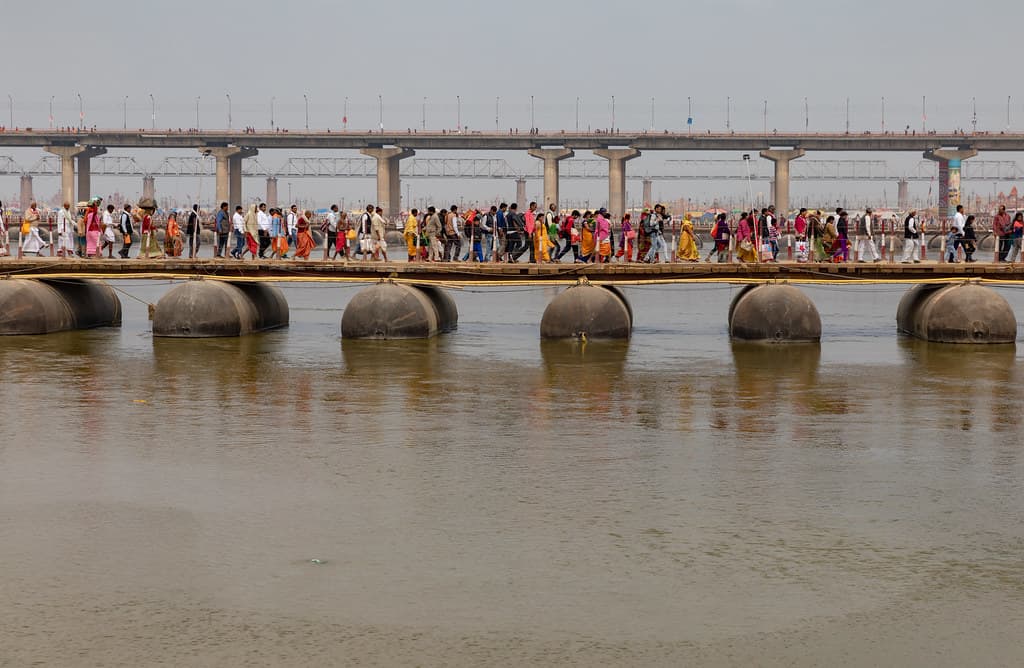
Its origin dates back to ancient legends of Hindu mythology. According to sacred texts, there was a colossal battle between gods and demons for possession of a kumbh (pitcher) containing the nectar of immortality.
During the chase, the god Vishnu accidentally spilled four drops of the nectar, which fell onto four cities in India. These places—Prayagraj (formerly Allahabad), Haridwar, Nashik and Ujjain—thus became holy pilgrimage cities and the rotating venues of the Kumbh Mela. Popular belief holds that bathing in the rivers of these locations during the festival grants divine grace to the devotee.
Historically, records of celebrations go back many centuries. Chronicles from the 7th century AD already describe large congregations of pilgrims bathing in Prayagraj.
Over time, the festival grew in attendance and organisation, consolidating itself as a pan-Hindu tradition. Today, it is held four times every twelve years, alternating between the four cities mentioned. In other words, approximately every three years there is a Kumbh Mela somewhere in India, rotating the host city.
- Prayagraj hosts the most crowded edition (known as the Maha Kumbh Mela when it coincides with certain special astrological alignments every 12 years).
- Haridwar, Nashik and Ujjain celebrate the other major editions.
For example, the 2025 edition in Prayagraj has been announced with record-breaking expectations, with 400 million pilgrims anticipated during the six weeks of celebrations. To put it into perspective, the previous edition (2019, of relatively lesser importance) still attracted around 240 million people.
Likewise, other cities such as Nashik or Ujjain attract tens of millions when it is their turn.
The four sacred venues and the Kumbh Mela calendar
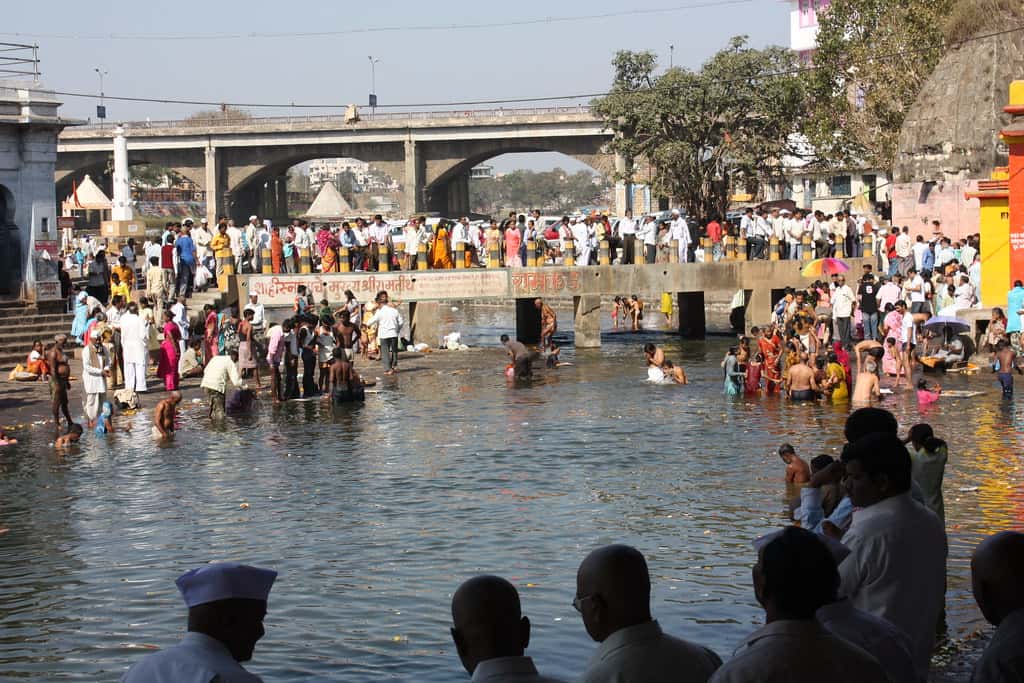
As we have said, this celebration takes place four times every twelve years, each time in one of these four cities: Prayag (Prayagraj), Haridwar, Ujjain and Nashik. Each is associated with a sacred river and a specific astrological sign, which defines the festival calendar:
- Prayagraj (Allahabad): a city situated at the confluence of the Ganges, Yamuna and Saraswati (Triveni Sangam). It is considered the most auspicious venue. The Maha Kumbh Mela is held here every 12 years (and the Ardh Kumbh every 6), when Jupiter is in Aquarius and the Sun in Aries.
- Haridwar: on the banks of the River Ganges at the foothills of the Himalayas. It occurs when Jupiter enters Aquarius and the Sun is in Aries (alternating with Prayagraj in the 12-year cycle). Haridwar was the venue in 2021 and will host it again roughly 12 years later. Millions of people come to bathe where the Ganges descends from the mountains.
- Nashik: a city in the state of Maharashtra, washed by the River Godavari. It shares with Ujjain the Kumbh Mela cycle when Jupiter enters Leo (a sign associated with the god Shiva). Nashik hosted the festival in 2015 and has its next major celebration scheduled for 2027. Although attendance is lower than in Prayagraj, it can attract tens of millions of devotees.
- Ujjain: located in Madhya Pradesh, on the banks of the River Kshipra. It is the fourth venue, also astrologically linked to Jupiter in Leo. Ujjain held its last Kumbh in 2016. It stands out for its temples dedicated to Shiva and for being an important centre for ascetic sadhus.
The full cycle repeats every 12 years. There is a belief that every 144 years an extraordinary Maha Kumbh Mela takes place in Prayagraj with even rarer alignments (although the term Maha is also commonly used for the 12-year editions in Prayagraj).
Between full Kumbh Melas, some cities celebrate Ardh Kumbh (half Kumbh) or smaller annual fairs to keep the local pilgrimage tradition alive.
A massive experience: rituals, logistics and challenges
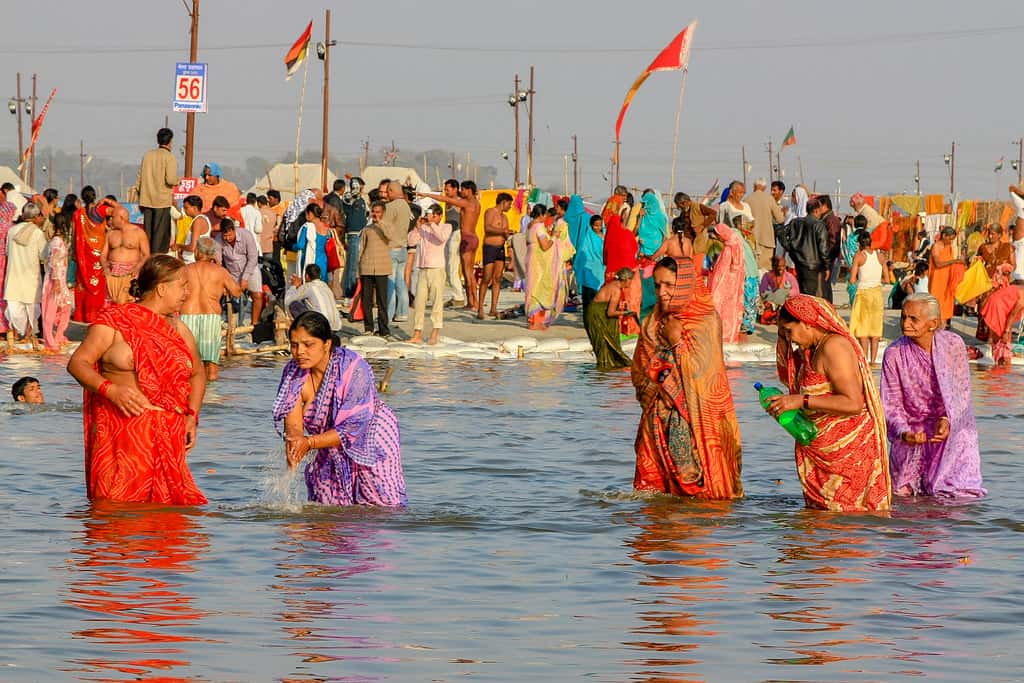
The central appeal of the Kumbh Mela is spiritual, but the experience itself involves enormous logistical complexity.
During the six weeks that the festival lasts, the host city must accommodate crowds equivalent to the population of an entire country. For example, in 2025 it is estimated that up to 400 million people will attend, a figure comparable to gathering the populations of the United States and Canada in a single place. Even for India (a country of 1.4 billion inhabitants accustomed to massive events), this represents a challenge of extraordinary magnitude.
- Infrastructure: the authorities build genuine temporary tent cities to house the pilgrims. In Prayagraj 2025, 150,000 public toilets and 68,000 lighting points were installed in a camp covering an area two-thirds the size of Manhattan Island. Field hospitals, drinking water stations, community kitchens and kilometres of temporary walkways and pathways along the riverbank are also set up.
- Daily rituals: before dawn, vast groups of pilgrims head to the river for the ritual bath. The most devoted try to reach the exact point of the river confluence —the Triveni Sangam— in overcrowded boats, while others are content to immerse themselves near the shore.
Drums and chants can be heard, and colourful processions can be seen: elephant entourages, tractors carrying statues of deities, and columns of kumbh (naked ascetics covered in ash) blessing the crowd. Everything unfolds in a fervent yet chaotic atmosphere, given the sheer number of attendees.
Hindus consider that “for a Hindu, it is an unmissable occasion”, since bathing during the Kumbh Mela is akin to immersing oneself in divine nectar.
- Pilgrim’s journey: unlike the Camino de Santiago, the Kumbh Mela does not have a single predetermined route that everyone follows; each pilgrim begins their journey from their place of origin to the host city of the festival. Many travel on overcrowded trains and buses or in trucks, sometimes for entire days, to arrive on the appointed dates.
- Safety and difficulties: Managing crowds of this scale is extremely difficult. A vast security operation is deployed: in 2025, 1,000 police officers, 2,700 AI-powered cameras, and aerial and aquatic drones were used to monitor the masses.
In addition, the huge scale brings sanitary issues (waste management, risk of disease), long waits for everything (from getting water or food to accessing the river), and the possibility of getting lost: it is common for people, especially the elderly, to become separated from their groups or families in the crowd.
- Meaning and spirit: despite the logistical inconveniences, the festival is experienced with enthusiasm and faith. Pilgrims endure the discomforts motivated by the spiritual conviction that this experience will grant them unique blessings. The atmosphere combines religious fervour, cultural celebration and solidarity (many volunteers offer help selflessly).
The festival is also a forum where gurus and spiritual leaders hold satsangs (discourses), share ancestral teachings, and practise rituals passed down for centuries.
After understanding its magnitude, it becomes interesting to compare this massive pilgrimage with the Camino de Santiago. Although they are very different experiences in terms of the number of participants and the way they are carried out, both share a background of faith, historical tradition and personal challenge.
Next, we will analyse the Camino de Santiago alongside the pilgrimage to the Kumbh Mela, considering aspects such as distance travelled, difficulties, logistics and history.
The Camino de Santiago and the Kumbh Mela: two great pilgrimages
If you already know or have heard of the Camino de Santiago, the Kumbh Mela can be understood as its “distant counterpart” in India, but on an entirely different scale. In reality, while on the Camino pilgrims walk day after day to reach the tomb of the Apostle, here millions of people gather in a sacred city to bathe in a specific river on very precise dates.
In both cases, there is a background of faith, tradition and personal quest, but the way the pilgrimage is experienced is entirely different. On specialised pages where information about the Camino de Santiago is shown, this difference is clear: the Camino is structured in stages, accommodation and services, whereas the Kumbh Mela is more like a vast temporary city that appears and disappears around the sacred river. And yes, you can also reach it as a pilgrim.
- On the French Way, the effort is measured in kilometres: around 800 km from the Pyrenees to Santiago, divided into daily stages of 20–30 km. The pilgrim faces climbs such as the León mountains or O Cebreiro, but benefits from good signposting, constant yellow arrows and a very dense network of hostels, bars and small shops.
-
- Nothing like the Kumbh Mela, where there is no linear route nor marked stages: each devotee arrives however they can at the host city, and the main challenge is not the distance but navigating through a gigantic crowd to reach the river and bathe.
- The Portuguese Way is a good example for comparing the “Western” physical effort with the spiritual climate of India. One of its most common stretches is the route from Porto to Tui, walked over several stages and combining flat areas with a demanding climb such as Serra da Labruja. Here, the difficulties are the slopes, blisters and weather conditions.
-
- In the Kumbh Mela, by contrast, the tiredness comes from the crowds, the long hours standing, the queues to reach the riverbanks and the constant need to stay alert not to get lost among millions of people.
- There are also Jacobean routes designed for those seeking a more intimate and symbolic experience. This is the case of the Spiritual Variant of the Camino. Here, the pilgrim relives the legend of the Apostle’s remains arriving by sea, in a setting of forests, monasteries and water. Silence, small groups and nature encourage introspection.
-
- In the Kumbh Mela, the opposite happens: the experience is lived surrounded by chants, drums, processions and preachers, with a collective energy that almost “carries” the pilgrim towards the river.
- Something similar occurs on less crowded routes such as the Via de la Plata and its final stretch from Ourense to Santiago. From here, the pilgrimage is completed in just a few days, with mid-mountain stages, rural landscapes and small villages where hostels and rural guesthouses form part of the experience. It is a more solitary route, where one can sometimes walk for hours without meeting anyone.
-
- At the Kumbh Mela, however, the idea of “walking alone” is almost impossible: on peak days, everything consists of queues, human currents and a density of people that forces one to move at the pace of the crowd.
Taken together, all the major Jacobean routes share a similar structure: reasonable stages, good signposting, frequent accommodation and a history dating back to the Middle Ages. The Kumbh Mela, for its part, does not propose a route to follow but rather an appointment in time and space: specific dates, a specific city and a specific river.
The pilgrim on the Camino de Santiago progresses day by day towards the goal; the pilgrim of the Kumbh Mela prepares for a single key moment, the bath, which lasts only a few minutes but which, for them, justifies the entire journey.
Despite these differences, both experiences share something: a mixture of exhaustion, emotion and gratitude when the goal is reached. Whether entering Obradoiro Square after walking hundreds of kilometres, or emerging drenched from the Ganges after managing to reach the water among millions of people, the pilgrim feels they have lived something unique.
In the end, both experiences are two different ways of responding to the same inner call: to set out in search of meaning, faith and a different way of looking at oneself and the world.