Talking about the Camino de Santiago usually immediately brings to mind trails, yellow arrows, hostels and walking stages. However, there is a Jacobean alternative that challenges this initial image: the Route of the Sea of Arousa and the River Ulla.
It is not understood solely by walking, but also by sailing. And that is precisely where its uniqueness lies: it commemorates the journey that, according to Jacobean tradition, the disciples of the Apostle Saint James undertook when they transported his body by sea to Galicia after his martyrdom in Jerusalem. It is a maritime–river route that recalls this episode, tracing its course from the entrance to the Arousa estuary, up along the River Ulla, and concluding with the final stretch on foot to Santiago.
For this reason, this route is not simply “a Camino with a boat”, nor a tourist add-on introduced later. Within the Jacobean world, it holds an exceptional symbolic value, as it refers to the Traslatio—that is, the transfer of the Apostle’s body.
Índice de contenidos
- 1 What exactly is the Route of the Sea of Arousa and the River Ulla?
- 2 The Traslatio: the great narrative that gives meaning to this route
- 3 The current route: from the open sea to the final stretch towards Compostela
- 4 The main heritage and symbolic highlights of the itinerary
- 5 Its role in today’s pilgrimage to Santiago
- 6 Infrastructure, logistics and what pilgrims should bear in mind today
- 7 How it compares with other Camino de Santiago routes
- 8 Why it remains one of the most unique Camino routes
What exactly is the Route of the Sea of Arousa and the River Ulla?

The Route of the Sea of Arousa and the River Ulla is an official Jacobean itinerary of a maritime and river nature. The Xunta de Galicia includes it among the Camino routes and explains that the ports of Ribeira and O Grove mark the entrance to the estuary. From here, there are around forty nautical miles to the ancient Iria Flavia (Padrón) and then approximately 25 kilometres on foot to Santiago. In other words, it combines two pilgrimage logics: first by water, then by land.
This dual nature makes it quite different from other Jacobean itineraries. Here, it is not only about crossing a territory, but about recreating a narrative. Sailing along the estuary and the river is not merely functional transport, but the re-enactment of a foundational episode.
Furthermore, it occupies a special place among the alternative routes of the Camino de Santiago, as it breaks with the idea that every pilgrimage must take place entirely on land. It does so without losing historical depth or spiritual meaning. On the contrary, its strength lies precisely in this amphibious nature, halfway between religious memory, the Atlantic landscape, and the continuity of the Camino towards Compostela.
The Traslatio: the great narrative that gives meaning to this route
To better understand it, we must look at the Traslatio. Book III of the Codex Calixtinus states that Saint James was transported from Jaffa, in Palestine, across the Mediterranean and along the Iberian Atlantic coast to the far western lands where he had preached. This episode forms the narrative foundation of the current route.
This is not a historical chronicle in the modern sense, but rather a religious and cultural tradition that took shape during the Middle Ages and became decisive for Jacobean identity. The Cathedral of Santiago explains that, once in Iria, the story connects with other well-known legendary episodes, such as the intervention of Queen Lupa and the search for a burial place for the Apostle.
This nuance is important. The Route of the Sea of Arousa and the River Ulla should not be interpreted as a literal and verifiable reconstruction of a 1st-century sea journey. In reality, it is the materialisation of a memory that has shaped the Compostela pilgrimage for centuries. Its value lies not only in archaeological accuracy, but in its ability to bring together tradition, territory, liturgy, art and the culture of the Camino.
From medieval tradition to the contemporary Jacobean route
Although the Traslatio refers to the symbolic origin of the Jacobean tradition, its contemporary formulation is much more recent.
The Ruta Xacobea do Mar de Arousa e Ulla Foundation places the origins of the project in 1963, when José Luis Sánchez-Agustino López presented the initiative as a tourism and economic development route. The first maritime–river ascent took place in 1965, and since then the annual procession has become one of its most visible milestones.
This helps to explain its evolution. The current route did not emerge as a preserved medieval relic, but rather as a contemporary reinterpretation of the Jacobean tradition. The Foundation itself recalls that it was declared of cultural and Galician interest by the Xunta in 1999. Today, the regional government includes it among the recognised routes in Galicia.
Its consolidation, therefore, is the result of a combination of factors: the recovery of the apostolic narrative, the enhancement of the heritage value of the Arousa estuary and the River Ulla, symbolic signposting through stone crosses, and its final connection with the Portuguese Way to Santiago.
The current route: from the open sea to the final stretch towards Compostela
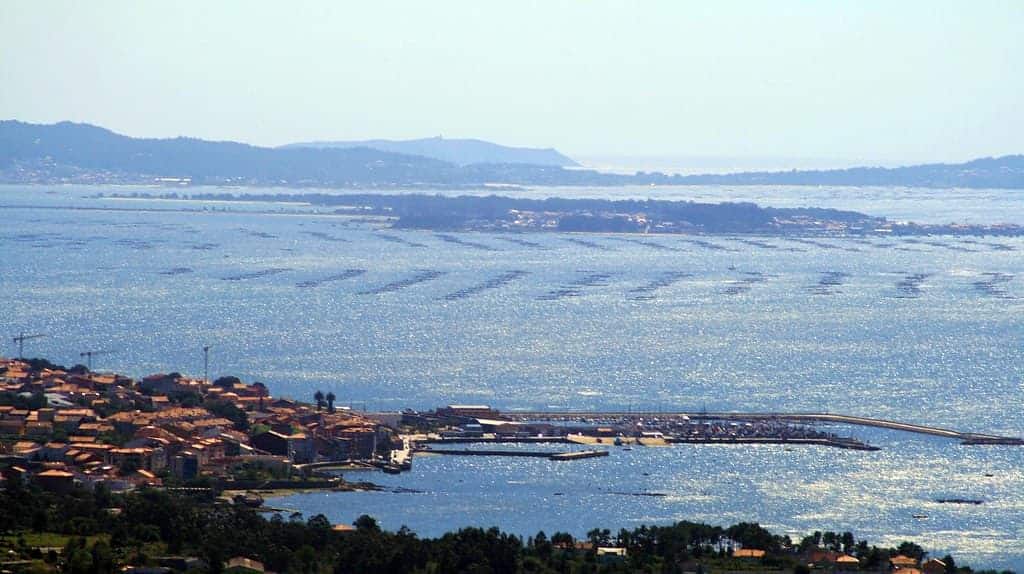
In practical terms, the itinerary begins at the mouth of the Arousa estuary. The main entry points are Ribeira and O Grove. In addition, there are two main approach routes: along the southern shore—Sanxenxo, O Grove, Cambados, Vilanova and Vilagarcía de Arousa, Catoira, Pontecesures, Padrón and Santiago; and along the northern shore—Ribeira, A Pobra, Boiro, Rianxo and Pontecesures, before linking with Padrón and Compostela.
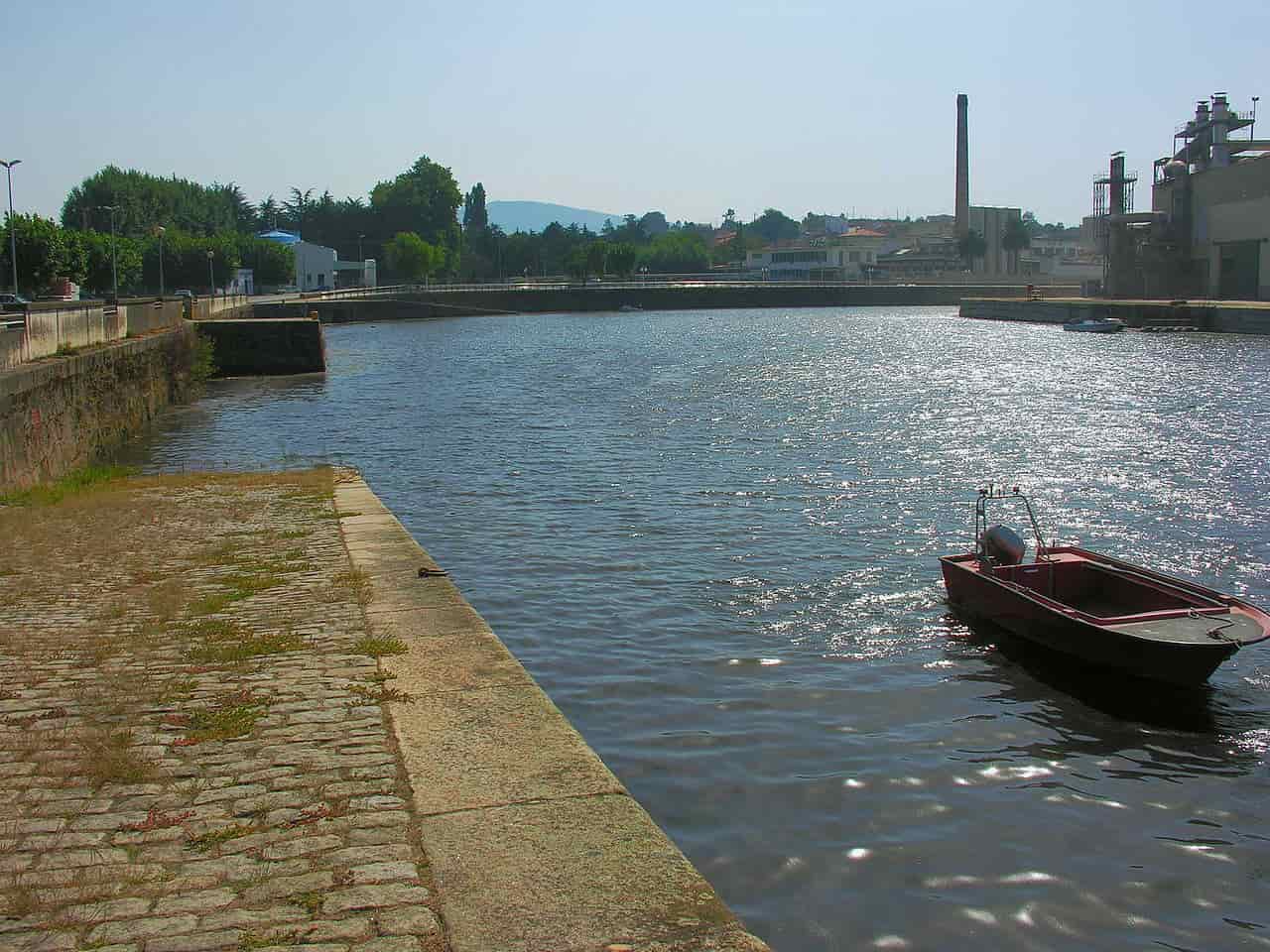
The key point is that the navigation ends in Pontecesures and in the area of Iria Flavia–Padrón, where Jacobean tradition concentrates some of its most powerful symbols. From there, pilgrims continue on foot to Santiago along the route shared with the Portuguese Way. From Pontecesures to Compostela, this land route is followed, while the official Padrón–Compostela stage is around 25 kilometres long.
This final stretch is far from incidental. On the contrary, it is what transforms a symbolic water journey into a complete Jacobean arrival. Passing through O Milladoiro, entering the city, and reaching the cathedral connect this route with the shared experience of thousands of pilgrims from other Caminos.
The main heritage and symbolic highlights of the itinerary
The Arousa estuary and its cultural landscape
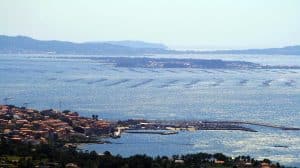
The route passes through one of the most complex and recognisable landscapes in Galicia. Not only for its beauty, but also for the cultural richness it encompasses: islands, mussel rafts, ports, shellfishing, vineyards, historic towns and religious heritage. A total of 22 municipalities from the provinces of Pontevedra and A Coruña are part of the Foundation’s board, reflecting its wide territorial and cultural scope.
The 17 stone crosses of the only maritime Way of the Cross in the world
One of the most striking features of the route is the 17 stone crosses placed along riverbanks and islets to symbolically accompany the journey. They form the only maritime Way of the Cross in the world, a uniqueness that is difficult to match within the wider Jacobean network.
They are not merely decorative. They serve as devotional markers, visual landmarks and defining elements of the itinerary.
Pontecesures, Iria Flavia and Padrón
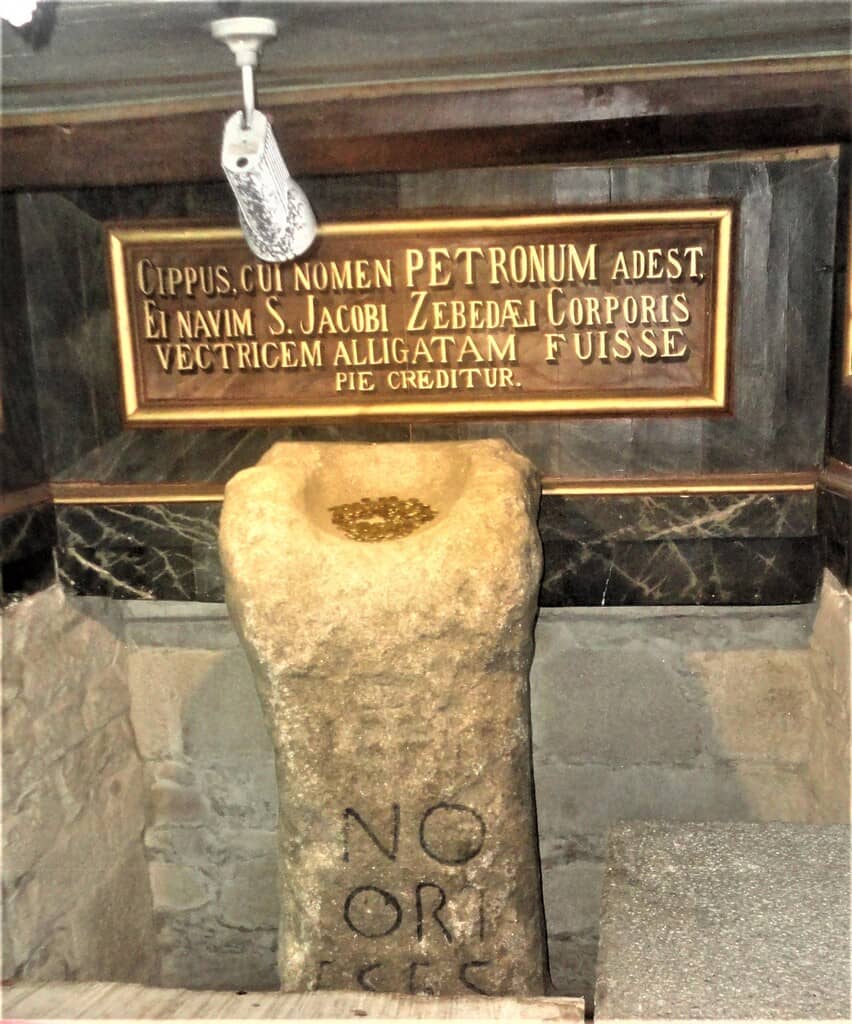
If navigation gives the route its character, Padrón provides its Jacobean depth. This town is regarded as the “cradle of the Jacobean tradition” and links its name to the Pedrón, a Roman altar dedicated to Neptune that tradition associates with the mooring of the apostolic boat.
The Padrón tourist office explains that this Pedrón is preserved beneath the main altar of the Church of Santiago and presents it as a key element of Jacobean culture. It also notes that the church was built beside the River Sar by Archbishop Xelmírez.
In the surroundings of Padrón and Iria Flavia, therefore, an essential part of the narrative is concentrated: river port, place name, memory of the landing, continuity towards Compostela and subsequent historical development. It is no coincidence that the route finds here its major transition point between water and land.
Its role in today’s pilgrimage to Santiago
In today’s pilgrimage landscape, the Route of the Sea of Arousa and the River Ulla occupies a very specific position: it is neither one of the most crowded options nor the easiest to organise, but it is certainly one of the most unique from a symbolic perspective. Compared to routes that stand out for their continuous footpaths, infrastructure or international popularity, this one excels for its direct connection with the origin story of the Jacobean tradition and its ability to combine sea, river and a final walking stage into a single experience.
It has also gained visibility thanks to its connection with the Spiritual Variant of the Portuguese Way, a route that links the land journey through O Salnés with the maritime–river crossing to Pontecesures.
In addition, the summer maritime–river procession continues to reinforce its public presence. Each summer, several decorated boats travel along the route towards Pontecesures and Padrón, maintaining a celebration that combines religious devotion, identity and cultural visibility.
Infrastructure, logistics and what pilgrims should bear in mind today
The first practical point is simple: this is not a route that can be improvised in the same way as a fully land-based Camino. Its core section depends on navigation and therefore on ports, boats, weather conditions and the specific logistics of each season. One thing is clear in official guidance: the pilgrimage continues on foot to Santiago, and the pilgrim’s credential remains the document required to certify the journey in order to obtain the Compostela.
Regarding certification, the Pilgrim’s Office states that for a sailing pilgrimage, 100 nautical miles are required, along with completing the rest of the Camino on foot from the landing port, collecting the corresponding stamps in the credential. It also reminds pilgrims that the goal of the Camino is the tomb of the Apostle and that coherence must be maintained.
This makes it necessary to distinguish between two aspects. One is the cultural and experiential value of travelling the Route of the Sea of Arousa and the River Ulla, which can be enjoyed as a unique Jacobean itinerary. The other concerns the specific requirements to obtain the Compostela, which depend on the current regulations of the International Pilgrim Reception Centre. It is always advisable to check the official rules in force before planning your journey.
On the final land section, logistics improve significantly, as the route connects with a well-established stretch of the Portuguese Way. This means access to services, clear signposting and a well-known entry into Santiago within the Galician Camino network.
How it compares with other Camino de Santiago routes
- Compared to the French Way. The great historical and popular reference of the Jacobean system. Its strength lies in the continuity of the route, the density of monumental heritage and the extensive network of services for pilgrims. The Route of the Sea of Arousa and the River Ulla, by contrast, does not compete in terms of scale or linearity: it offers something different, more concentrated and more symbolic.
- For those wishing to compare specific sections of the French Way, you can explore the French Way from Logroño or the French Way from Burgos.
- Compared to the Northern Way. While the Northern Way shares with the Arousa route a connection to coastal landscapes, the experience is very different. The Northern Way is a long-distance route, physically demanding in many sections, with an identity shaped by cliffs, fishing villages and constant ascents and descents.
- For a reference section along the Cantabrian coast, you can look at the Northern Way from Gijón, where the presence of the sea is experienced in a completely different way: always on foot, never navigating upriver towards the heart of the Jacobean tradition.
-
- Compared to the Portuguese Way. In fact, both routes physically meet on the final stretch from Padrón to Santiago. The main difference is that the Route of the Sea of Arousa and the River Ulla introduces a nautical component that the traditional Portuguese Way does not have. When integrated into the Spiritual Variant, the comparison becomes even more interesting: monasteries, the landscape of O Salnés and a river crossing before returning to the land route towards Compostela.
- Compared to the Primitive Way, the English Way or the Via de la Plata. Other official routes stand out for very different reasons.
- The Primitive Way stands out for its difficulty and strong early medieval historical significance.
- The English Way is known for its shorter length and its connection with pilgrims arriving by sea to northern Galicia.
- The Via de la Plata is notable for its length and the vast territory it crosses.
Why it remains one of the most unique Camino routes
The Route of the Sea of Arousa and the River Ulla continues to stand out because it brings together several layers that rarely coincide so clearly within a single itinerary. It has a foundational layer linked to the Traslatio; a landscape layer shaped by the estuary, the River Ulla and the surroundings of Padrón; a heritage layer visible in the stone crosses, Iria Flavia and the Pedrón; and a contemporary pilgrimage layer that connects it with the final arrival in Compostela.
It also offers something rather uncommon: it encourages us to think about the Camino in broader terms. Not merely as a sequence of stages and kilometres, but as a network of narratives, landscapes and historical ways of approaching Santiago. In this sense, its value goes beyond the specific experience of sailing. It represents a different way of understanding the Jacobean tradition.